Making Sense of NAFTA and Its Replacement
Why we need new economic policies before we can fix trade deals
By STAN SORSCHER
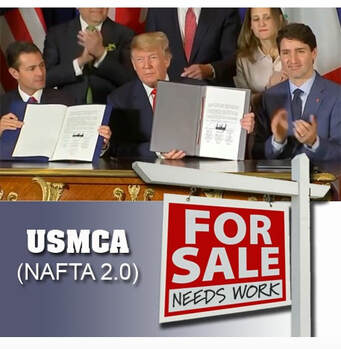
(June 10, 2019) — In 2016, Donald Trump’s trade message was very simple: the North American Free Trade Agreement (NAFTA) was the worst trade deal ever negotiated. He has renegotiated NAFTA, rebranding the deal as the United States-Mexico-Canada Agreement (USMCA). We never quite understood his objection to the original NAFTA, and we don’t understand how USMCA fixes it. You need to squint to see the difference between NAFTA and its replacement.
“I have a gut, and my gut tells me more sometimes than anybody else’s brain can ever tell me,” Trump has said. His gut instinct said NAFTA was bad. Unfortunately, gut instinct is typically simplistic, often impulsive, and by definition not strategic or coherent.
We need to think of our domestic policy and trade policy together. Tariffs, like trade deals, make sense only as tools within a larger coherent strategy. Trade policy should reinforce the principles in our domestic policy. If trade policy is not working, it’s a fair bet that our underlying domestic policies aren’t either.
Since 1980, the prevailing political messagehas been, “Markets will solve all our problems. Government is the problem.”
The term for this is neoliberalism. “Neo” means new. In the language of economics, “liberal” means “liberated” or free from regulation. Neoliberalism “frees” markets by shrinking government, dismantling social programs, and cutting investment in education and research-and-development.
Many of our biggest problems — climate change, growing income inequality, health care, food safety, and workplace safety — are textbook market failures. Neoliberalism responds with its universal prescription — make business succeed and well-being will follow.
Read more.
Making Sense of NAFTA and Its Replacement. (opens in a new tab)
Comments
No comments yet.
Leave a comment
Comments are reviewed before they appear. Your name is shown with your comment.