Blog, page 21 of 25The senator on the protests, his phone calls with Joe Biden, and when to compromise. By Andrew Marantz June 9, 2020 In 1997, during his fourth term as a U.S. representative, Bernie Sanders published a political memoir called “Outsider in the House (opens in a new tab).” On the book’s cover, superimposed over an image of the Capitol, was a photo of Sanders, with his signature Coke-bottle glasses and mussed gray hair, raising his arm in a closed-fist salute. At the time, he was the only member of Congress who was neither a Republican nor a Democrat. This was the essence of his public image: in the establishment, but not of it. The previous year, Bill Clinton had won reëlection, in part, by running to the right of the Republicans on several issues. Sanders, who described himself interchangeably as “a progressive” and “a democratic socialist,” ran far to Clinton’s left. “This is a book about hopes and dreams that will not be realized in our lifetimes,” Sanders and his co-author, a poetry scholar at the University of Vermont named Huck Gutman, wrote in the introduction. “It examines the two major political parties—neither of which comes close to representing the needs of working people—and the frustrations and successes of helping to create an independent progressive political movement.” Sanders seemed to define “success” as a long career in Congress, during which he could continue his quixotic advocacy for “programs which sustain the weakest and most vulnerable among us,” such as “health care for all people as a right of citizenship.” In 2015, the book was reissued under a new title: “Outsider in the White House (opens in a new tab).” On the new cover, Sanders, now a senator, looked more or less the same—he has looked more or less the same since 1987 (opens in a new tab)—but the raised fist was gone, replaced by a professional-looking haircut and an innocuous grin. The question posed by the book’s final chapter, “Where Do We Go From Here?,” now had a simpler answer: vote for me for President. “The majority of Americans today are outsiders,” the new preface read. “Together, we can remake our politics and our governance so that none of us are outsiders anymore.” In 2016, and then in 2020, Sanders fell short of taking over the Democratic Party and capturing the Presidency. But he did remake our politics. Throughout the interminable primary campaign of the past year, in televised debate after televised debate, Sanders stood near the center of the stage, delivering the same populist talking points he’d been repeating for four decades. His more Clintonian opponents ran to his right; a variety of other candidates looked for signature issues—Julián Castro on immigration, Beto O’Rourke on gun control—that might allow them to outflank Sanders from the left. In the end, Democratic voters coalesced around Joe Biden, but exit polls indicated (opens in a new tab) that a majority of them supported Sanders’s platform, including Medicare for All. In the most recent Morning Consult poll (opens in a new tab), Sanders was the most popular senator in the nation. Recently, with the covid-19 pandemic still raging and protests against police brutality lighting up cities and towns around the country, I spoke to Sanders by phone. Our conversation has been edited and condensed. I have to start by asking you about everything that’s happening in our country right now. Many people are comparing this moment to 1968. You lived through the sixties. You were arrested at civil-rights protests in the sixties. What do you make of that comparison? The sixties were largely provoked by opposition to the war in Vietnam, by racism, by economic injustice. And what we’re seeing now, and why we have perhaps hundreds of thousands of people in the streets, is focussed on systemic racism, on police brutality, and police murder. But I believe also that a lot of that anger that so many people are feeling goes beyond police murder, and it goes to the fact that we have a President who is a narcissist and a pathological liar. It goes, I think, into an economy in which many of the young people who are demonstrating today don’t have jobs, and the likelihood is, unless we make fundamental changes, they’re not going to have jobs. And it goes to a health-care system which is clearly dysfunctional, and it goes to neglect about the crisis of climate change. So I think it speaks to the over-all powerlessness that people are now feeling amidst all of the crises that we are experiencing with, clearly, a President who is a fraud and a danger to the country. You add all that stuff up, you got millions of people who are angry and are trying to fight back. Since you mentioned the danger of the President: in the past, you have called Donald Trump an “authoritarian leader.” In 2018, there was a video (opens in a new tab) on your Senate Web site called “Flirting with Fascism,” which was obviously about Trump. Now that he’s openly considering calling for the military to quell a mostly peaceful protest movement, do you think it’s time to call Donald Trump a fascist? Doesn’t matter what you call him. I’m not worried about what you call him. I was very impressed by the statement of Jim Mattis, the former Trump Secretary of Defense, who made the very simple point that, in a democratic society, a society that has a Constitution, you don’t call out the military against civilian demonstrations. So the issue is, I think, you have, clearly, a President who, time and time again, has shown his authoritarian tendencies, who has shown his affection, deep affection for authoritarian leaders all over the world—in Eastern Europe, in China, in North Korea, in Russia—who introduced us to a military parade in Washington, D.C., and who is indicating now his desire to see our U.S. military attack civilian demonstrators. So I don’t care what you call it, but, clearly, we understand that we have a President who has very little understanding of the Constitution, a complete disregard for civil liberties in this country, and who will do anything that he can for his own political purposes and his own financial purposes. This is a narcissist who could care less about anything other than his own political power and financial well-being. When you announced the suspension of your Presidential campaign, in April, you said, “Our movement has won the ideological struggle.” You listed a few of the ideas that you’ve pushed for for years now—a fifteen-dollar minimum wage, universal health care—which were once fringe and are now mainstream. What are the most urgent things that you intend to do, especially in the five months between now and the election, to translate those ideological victories into tangible policy victories? As a United States senator, I’m going to do everything that I can to make sure that another major piece of emergency legislation is passed as quickly as possible to deal with the extraordinary suffering that the working families of this country are experiencing right now. It’s very easy to ignore the reality that you’ve got millions of families in Vermont, and across this country, who literally have no food in their cupboards right now; who are scared to death; and, in fact, are being evicted from their homes, from their apartments, or are losing their homes. So where my attention is right now is to do everything I can as a senator to make sure that we move forward as quickly and aggressively as we can for a major piece of legislation which addresses the crises facing working families today. That means, in my view, the need for what we call a Paycheck Security Act, which does what European countries do, and that makes sure that every unemployed worker continues to receive his or her paycheck and the benefits that go with that. For those who don’t [have health care], I want Medicare to cover all health-care needs during the crisis. I believe every family, every individual, should get two thousand dollars a month during the crisis. We’ve got to save the Postal Service, which is a huge issue, and make sure that everybody has enough food to survive on. So that’s the immediate crisis. Longer-term, obviously, what I am trying to do is to bring people together to defeat Trump and to elect Biden. It is no great secret that Joe Biden and I have very serious political differences, but, at this particular moment in history, what is most important is to defeat Trump, who, as you implied a moment ago, is literally a threat to American democracy, and is moving this country not only in a dangerous way but in an authoritarian way, as well. Trump has got to be defeated and, in a variety of ways, I intend to play an active role in that process. Thirdly, it is not good enough just to elect Joe Biden. We’ve got to continue the movement in this country for transformative change, and to understand that we are way, way, way behind many other industrialized countries in providing for the needs of working families. So the fight continues for a Medicare for All single-payer program, and that becomes especially obvious when you have seen in recent months millions of people losing their jobs. They’re also losing their health care because, under our system, health care is an employee benefit not a human right. So I’m going to continue that fight, and, no question, we are gaining momentum at the grass roots. And on and on it goes. I think one of the myths that is being exploited right now is that I hear my Republican colleagues talk about, Well, you know, yes, this pandemic has been devastating, but, a few months ago, we had this great economy. This really great economy. I don’t know how you have this “great economy” when half of your people are living paycheck to paycheck. And what we are seeing right now, the great economic message of today, is that, when you live paycheck to paycheck and you miss a few paychecks, a few weeks of work, your family is suddenly now in economic desperation. Literally. Struggling to put food on the table and pay the rent. So we’ve got to rethink. If there is anything that I hope we achieve in the midst of this unprecedented moment in American history, it’s that we use this moment to rethink, as I have said before, some of the basic tenets and institutions of American society, and learn from this pandemic and economic collapse so that we move this country in a very, very different direction. There are essentially two views that you hear from the left about this upcoming election. There’s a group that says, Biden and the Democratic Party have not done enough to earn my vote, and this is no time for compromise. And those people might feel that way even more strongly now, given the understandable despair over the killing of George Floyd and so many other horrific manifestations of oppression. The other view you hear is from people like Noam Chomsky, who said (opens in a new tab)that, if you live in a swing state, “the alternative to voting for Biden is voting for Trump,” and that that’s essentially voting for “the destruction of organized human society.” Which of those two views do you agree with? Oh, obviously, I support what Chomsky is saying. It is very easy for somebody to stand up and say, truthfully, “I disagree with what Joe Biden stands for, his politics are much too conservative.” I get that. I share that view. But not to understand what it would mean to this country, and to our children and to our grandchildren—I have seven grandchildren—and what it will mean to this planet in terms of climate change if Trump is reëlected is, to me, to miss the most important point that has to be made. Trump cannot be reëlected. And what we have got to do, if you are unhappy with Biden’s politics, if you disagree with Biden’s politics—and I certainly do—then the fight has got to take place, starting today, to make sure that he moves in as progressive a way as possible, that his Administration is as progressive as possible. The New Yorker Interview (Ed.: Read the entire piece (opens in a new tab). Sanders addresses many of the critical questions being discussed in the North Star Caucus.) Democratic Left MARCH 7, 2020 By Daniel Denvir Donald Trump is in the White House, so it might surprise you to learn that U.S. support for immigrant rights is at a historic high. In 1994, 63% of Americans agreed that “immigrants are a burden on the country because they take jobs, housing and health care,” according to the Pew Research Center. By 2019, 28% thought that, while 62% agreed that “immigrants strengthen the country because of their hard work and talents.” The Republican Party has made xenophobia a cornerstone of its politics. But Democratic voters have moved in the opposite direction. And fast. Until a decade ago, Republicans and Democrats held similar opinions on immigration. Then they diverged sharply. Last year, 83% of Democrats had positive views of immigrants, compared to 38% of Republicans. And Republicans who oppose immigration have come to oppose it in more brazenly racist terms, growing more likely since Trump took office to believe that the United States risks losing its identity if it is too open to immigration. At the same time, immigrants and an increasingly diverse Democratic Party base have emphatically supported of immigrant rights and freedom. The task of the Left is to join the immigrant rights movement in forcing Democratic politicians to catch up to their base—or, if necessary, to replace those politicians. Under Presidents Bill Clinton, George W. Bush, and Barack Obama, the war on immigrants was bipartisan. But escalating enforcement and the spectacular demonization of immigrants provoked a powerful movement in response. Starting in 2006, that movement began to weaken xenophobia’s hold on the Democratic base, even as Republican xenophobia become more radical. Today, nativism is increasingly a project of a right wing that—while tenaciously using anti-democratic levers to maintain power—is in long-term decline. This polarization presents dangers, as when Trump moves to terrorize asylum-seekers and ban Muslims and Africans. But it also provides immense opportunities for the immigrant rights movement, because the bipartisan war on immigrants can’t continue as such without bipartisan public support. It’s an opportunity for the socialist Left to put immigrant workers at the core of an agenda that transforms this country for all workers. It’s no coincidence that immigrants and their children—Latinos and Muslims in particular—are now core to Bernie Sanders’s base. Sanders pledges not only to end the war on immigrants but also to transform the rotten system that made it possible. Bernie has a stellar immigration plan, but it’s his universal class-struggle politics that has been key to drawing the support of Latinos, who’ve long been central to an emerging multiracial U.S. working class and its labor struggles. For decades, immigrants have been stigmatized for using social services, softening up the public for an attack on everyone’s social services. Sanders’s proposal for Medicare for All includes undocumented people, a radical break with an ugly history of using racism and xenophobia to attack the welfare state. The Right wins when it uses racism to divide ordinary people against one another. The Left wins when it embraces a capacious and inclusive “we the people” against economic elites. That is why we’re starting to win right now. During the 1990s, Bill Clinton co-opted Republican nativism, painting immigrants as a welfare drain and criminal threat. With support from both parties, Congress militarized the border and passed laws that connected the deportation machine to the country’s criminal justice system. It also made deportations more difficult to fight, and deportees’ exclusion more permanent. After the attacks of September 11, 2001, immigrants came to be portrayed as a terrorist threat, and the deportation machinery was attached to the national security state. Presidents George W. Bush and Barack Obama (the latter earning the moniker “Deporter in Chief”) pushed for more deportations and more border crackdowns—in the hope of winning right-wing members of Congress over to “comprehensive immigration reform,” which combined legalization of undocumented people with guestworker programs and new enforcement measures. The right wing, however, consistently refused to support anything that looked like “amnesty.” They accepted the crackdowns as a free gift, offering nothing in return—all while further radicalizing their position and accusing Democrats of advocating open borders. Any Democrat who defeats Trump will likely at minimum reverse escalations in the long-running war on immigrants—such as his Muslim ban and deep cuts to refugee admissions. We on the socialist Left must work with organizations like the National Day Laborer Organizing Network and Movimiento Cosecha and others in fighting for just bills and executive actions that demilitarize the border, legalize undocumented immigrants, and break the ties between the criminal justice and immigration enforcement systems— rejecting all compromise with the nativist Right. What history demonstrates is that such compromises are not only morally odious as policy but also disastrous politically. For decades, the liberal establishment has abetted nativist politics and caused misery for immigrants. But worker freedom depends on immigrant freedom, because immigration status is used to divide the working class. And immigrant freedom depends on worker freedom, because immigrant struggles on the job are inseparable from their struggles for legal status. The good news is that immigrants are at the center of a U.S. working class that is starting to fight back and win. From Democratic Left Posted with permission March 7, 2020. https://www.dsausa.org/democratic-left/4583/ (opens in a new tab) About Daniel DenvirProvidence DSA member Daniel Denvir is a visiting fellow in International and Public Affairs at Brown University, host of The Dig podcast on Jacobin Radio, and author of All-American Nativism: How the Bipartisan War on Immigrants Explains Politics as We Know It (Verso, 2020). https://www.dsausa.org/democratic-left/4583/ 0 Comments on How the Bipartisan War on Immigrants Explains Politics as We Know It 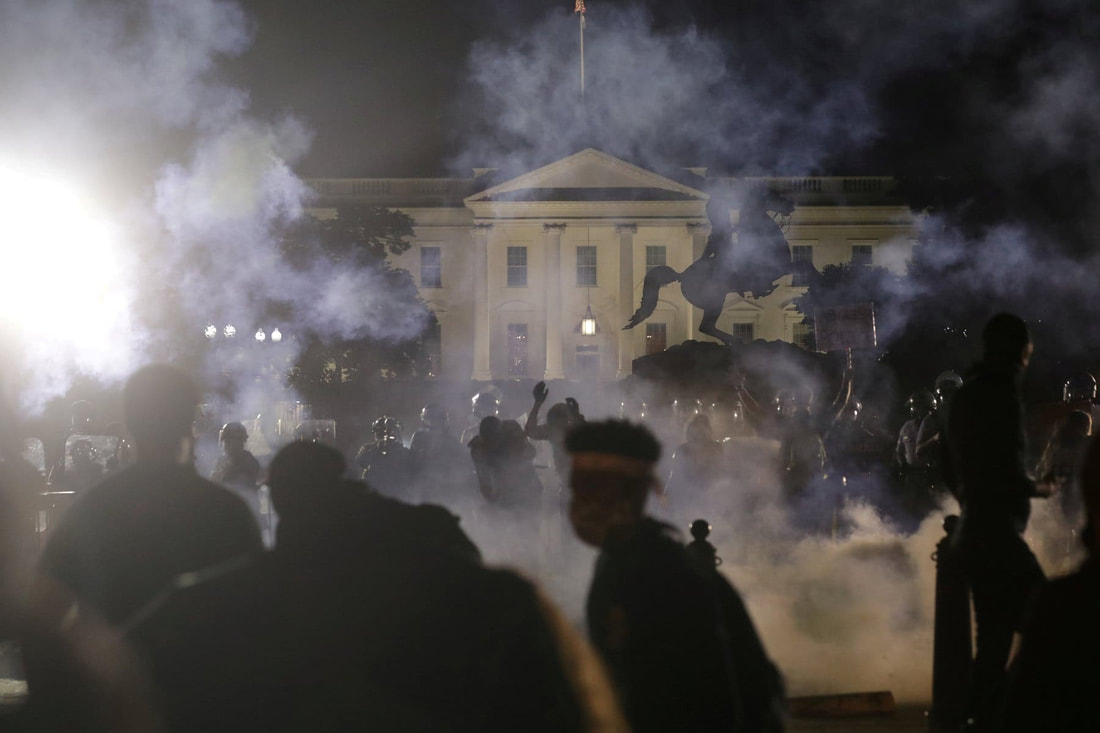 By Harold Meyerson https://prospect.org/civil-rights/sending-in-the-troops-a-brief-history/ Within just a single hour on Monday afternoon, Donald Trump broke new ground for an American president in two distinct ways. First, in awkwardly and hesitantly brandishing a Bible outside St. John’s Church, he became the first U.S. president to publicly demonstrate how unaccustomed he is to actually holding a book. (“A Bible? I won’t have to read from it, will I? Is this the same one I got sworn in on? Can I just take the oath for my second term and be done with all this election shit?”) Second, and more importantly, Trump also casually announced he’d send in the troops—which could mean federalizing the National Guard or actually unleashing the Army on America’s cities—if he thought governors and mayors weren’t sufficiently beating the crap out of protesters or rioters (it wasn’t clear which from what he said, and from the way such actions usually play out). What was clear was that he saw such action as a way to intensify his campaign against the Democrats in this year’s election: He’d come off as the tough guy (and presumably more effectual than he’s been in dealing with the pandemic and the economic collapse), while painting the Democrats as the world’s worst wusses. It’s the absence of all calculations save the political that makes Trump’s intervention something new under the American sun. After all, presidents have sent in the troops before under a range of conditions. Rutherford B. Hayes sent in the Army to break the nationwide railroad strike of 1877, while Grover Cleveland did the same during the Pullman Strike of 1894. Interventions on behalf of equal rights have happened, too: In 1863, Abraham Lincoln sent Union troops (some of whom were still recovering from fighting at Gettysburg) to New York to suppress an anti-draft riot that had turned into a mass lynching of African Americans. In 1957, Dwight Eisenhower sent troops to Little Rock to protect the first nine black children to integrate a school there. And throughout most of his two terms as president, Ulysses Grant deployed federal troops to the South to enforce Reconstruction and suppress the Ku Klux Klan. Though the actions Grant ordered were increasingly unpopular in not just the white South but the white North, too, and though Grant understood full well the depth of their unpopularity, his sense of duty and fairness compelled him to keep dispatching the troops. It’s the absence of all calculations save the political that makes Trump’s intervention something new under the American sun. Sometimes, a sense of duty and fairness, abetted by prudence and calculation, has kept a president from sending in the troops when powerful interests have clamored for it. I’ve written on several occasions that the most radical thing Franklin Roosevelt ever did was … nothing. When San Francisco and Minneapolis were shut down in 1934 by general strikes, American big business and conservatives demanded FDR send in the troops; many of them did the same when autoworkers illegally occupied General Motors factories in Flint, Michigan, in the winter of 1936-1937. During the San Francisco strike (at which time, Roosevelt was Hawaii-bound in mid-Pacific, on the cruiser Houston) and the other worker uprisings, however, Roosevelt declined to deploy the Army. As he told reporters, off the record but recorded nonetheless, “In the San Francisco strike a lot of people completely lost their heads and telegraphed me, ‘For God’s sake, come back; turn the ship around.’ Everybody demanded that I sail into San Francisco Bay, all flags flying and guns double-shotted, and end the strike.” By refusing to move against striking workers in 1934, FDR laid some of the groundwork for the enactment of the National Labor Relations Act one year later. By refusing to move against the GM sit-downers, he midwifed the birth of industrial unionism and the creation of a decently paid working class, which endured for the next 40 years. But even among presidents who did send in troops, not a one did so for such purely electoral calculations as Trump—as ever, blazing a new path in America’s journey, albeit straight to hell. (Ed.: See post below. The Fierce Urgency of Now.) We have seen in the recent actions of Trump how he would move to consolidate authoritarian power. He claimed the nation was in danger. He claimed the danger was from Antifa. Here is the statement of the Communications Workers of America: https://cwa-union.org/news/releases/statement-cwa-executive-board-on-need-dismantle-racism-plagues-our-communities He claimed the right to use military force even over the opposition of some governors. He used the military force in the Washington D.C. event- now described as a photo op. He has turned it into a campaign video claiming that he alone protected religious institutions. His media camp has endorsed and supported him. Military forces and police forces cooperated with him in an unconstitutional seizure of power. Naomi Klein makes a good case in No is Not Enough, that we should prepare to resist a seizure of power. As responsible citizens, we should begin to plan for resistance. For example, we could plan to resist the imposition of a curfew by mass demonstrations. We will need ways to control those who will provide the Trump regime an excuse for repression with their looting. The military action taken by Trump and Barr strongly reinforce our need to continue to work toward the defeat of Trump in the 2020 elections if those elections go forward. The need to defeat Trump in the elections is even more urgent today than it was two weeks ago. National DSA is beginning a process of creating a new strategic plan. Certainly, the new urgency to defeat Trump should be reflected in DSA planning. Duane Campbell Assessing the Nagle/Tracey Argument – and Some Alternative Explanations By Bill Barclay Ventura County DSA and CPEG The 2020 Sanders presidential campaign underperformed compared to the 2016 campaign: fewer delegates, lower vote shares and often even lower numbers of raw votes. This is the issue that underlies the recent “First as Tragedy, Then as Farce” article by Angela Nagle and Michael Tracey (hereafter N&T) in American Affairs magazine. I realize that N&T don't really formulate their analysis in quite that way, and their tendentious approach to the Mueller investigation, Russia, DSA, etc. sometimes obscures this question. But that loss of voters, in both numbers and shares of total Democratic primary vote, is central to their argument. More importantly, it should also be the focus of any discussion among socialists in this country trying to assess what happened (or failed to happen) in the Sanders campaign. And, while Dustin Guastella's critique of N&T in Jacobin makes some interesting points, I think he doesn't engage the central question that underlies N&T article: So, why did Sanders 2020 campaign underperform his 2016 campaign? As N&T note, correctly, Sanders had many advantages coming into the 2020 campaign cycle that he did not possess in 2016: name recognition, no single dominant opponent, a large and committed base, etc. (I don’t think, contrary to N&T, that he had “unlimited amounts of money.” Only one Democratic presidential candidate had that.) But his underperformance is all the more striking given the 2018 surge of Democratic voters that took back the House by flipping more than 40 seats held by Republicans. I’ll begin by looking at the two arguments that are the core of the N&T article. Their first argument is that the Sanders campaign had a theory of the electorate that didn't match well with reality. They note, correctly, that Sanders consistently stressed the need to expand the electorate, that his best chance of winning would be to bring new voters into the political arena. Of course, Sanders was not alone in this argument. Indivisibles, Stacy Abrams, DSA., etc. have all sought to expand the electorate, also believing that this would benefit progressives (if not necessarily Sanders). After the Iowa debacle, turnout for Democratic primaries did increase overall and very significantly in some states, e.g., by 68% in Virginia, 45% in South Carolina, 32% in Michigan (see here: http://centerforpolitics.org/crystalball/articles/2020-turnout/ (opens in a new tab)). But the increase did not favor Sanders. Why? N&T argue that the youth-focused voter mobilization of the Sanders campaign was unable to significantly increase this demographic. Instead the increased Democratic primary voter turnout favored Biden rather than Sanders. So, who turned out? The increased Democratic primary turnout was driven primarily by college educated voters, especially those in the suburbs. In fact, the under-30 share of the Democratic primary vote declined in several states, especially on the important Super Tuesday states (https://www.usatoday.com/story/news/politics/elections/2020/03/04/super-tuesday-bernie-sanders-youth-votes-fell-short-compared-2016/4947795002/). In addition, although Sanders had led the effort to switch states from caucuses to primaries, he lost all states that switched. These losses underline the failure of increased turnout to power the political revolution thesis of the Sanders campaign. Thus, this first piece of the N&T argument, that the Sanders campaign had a poor understanding of the Democratic electorate, appears accurate. The second argument advance by N&T, and one they try to tie to where the increased voter turnout went, is more controversial: that the Sanders of 2020 was not the Sanders of 2016. The cause, they believe, was the rise of woke culture on the left and the redefinition of Sanders and his campaign to identify with, or even try to personify, that culture and milieu. This, they believe, was a fatal weakness in the campaign. (It seems to me that, to some extent, the Guastella piece accepts that this was a weakness in the Sanders' campaign; this is implicit in the very title, “We Need a Class War, Not a Culture War,” even though he doesn’t agree with the weight given to it by N&T.) At first glance this link between increased turnout and a rejection of woke culture may seem reasonable, but it sits uncomfortably with some of the rest of the article and the demography of the surge in Democratic primary turnout. N&T argue that working class and rural voters are not comfortable with political correctness, woke culture or whatever else you may call it. And, it was these voters who supported Sanders in 2016 but deserted him in 2020 as the campaign moved in that direction. But at other times, N&T suggest that these demographics pay little attention to events such as the Mueller investigation, impeachment, etc. If this is actually true (doubtful, I think), then these groups would also be less aware of the "wokeness" of the campaign. In this instance, I think N&T’s political agenda, an obvious dislike for “wokeness,” drives their analysis. Further, as noted above, the primary driver of the increase in turnout for the Dem primaries was college educated, suburban voters. I think these demographics, while they may not fully partake of the woke culture, are less likely to be put off by it. So, while I certainly agree (with N&T and Guastella) that there are very dislikeable aspects of on-line and in print “wokeness,” I don’t think N&T have made their case. A caveat: I’m not sure we can completely dismiss their argument. I don’t know the internal workings of the South Carolina Sanders operation, but if N&T are accurate, the PC culture that even Guastella agrees is widely disliked appears to have had a devastating impact at a crucial moment in the campaign. So, half right to N&T. But I think there are three explanations for Sanders 2020 shortfall that neither N&T nor Guastella come to grips with. First, Sanders’ opponent – his only opponent – in 2016 was Hilary Clinton. While Clinton had a committed following, she was also the nationally known Democrat with the highest net negative ratings in the voting population at large. This rejection of Clinton was driven both by the perception of her as part of a Democratic Party elite that was out of touch with most people who called themselves Democrats, the fact that she was female, and the long-term right-wing efforts to undermine her credibility and trustworthiness. She came as close as she did to wining because Trump’s net negatives were as high or even higher. (See here for some data on the issue of anti-Clinton vote in the 2016 Dem primaries: https://www.nytimes.com/2020/03/11/opinion/sanders-trump-biden.html.) Given a wider range of choices in 2020, those voters who did not accept Sanders’ analysis of what is wrong with the United States and how we need to address it, chose other candidates – because they had the option to do so. A second factor is the continued inability of the Sanders campaign to attract significant support from African-Americans. There is some age gradation: better among the youth but not enough better to make substantial inroads in this heavily Democratic demographic. I saw this problem in 2016 when working for him in Chicago. Clinton won all the African-American wards and split the white wards more or less evenly with Sanders. Sanders won the Hispanic wards. I don’t have an explanation but is certainly the case that Sanders should have approached James Clyburn early on; his endorsement of Biden is widely credited with driving the big win for Biden in South Carolina. (I think he would have won anyway, just as Clinton did in 2016). A final overlooked reason for the difference between 2016 and 2020 is the distance from the Great Financial Crisis (GFC) of 2008/09. Although I have argued that we are still living in a world defined by the GFC, it probably didn’t seem that way to many voters, such as the ones I met who complained that Sanders was saying the same thing he did four years earlier, that he hadn’t evolved with the times. Of course, for many of his supporters this is a strength, but it was also, I think, a weakness in the eyes of many. Remember that in the primary season of 2016, unemployment levels were still higher than pre the GFC and had only slowly been coming down and foreclosures were still common. In contrast, in the truncated primary season of 2019/20 before Sanders dropped out, unemployment was at the lowest level in five decades. Overall, I think these factors were more important in Sanders’ under-performance in 2020 than those cited by N&T. If I’m right, particularly about the anti-Clinton vote, it requires us to recognize that what we on the Left took as widespread support for at least a social democratic vision, based on 2016 votes for Sanders, was actually less widespread than we thought/hoped. There may also be the need to face the problems of woke culture more squarely and also think about how the Left can forge a kind of nationalism that does not compromise our politics but also recognizes the economic threat of an unrestrained flow of labor across national borders between countries with very different wage levels. But that’s an issue for another discussion. A last thought: if the economy loomed less large in Democratic voters’ decisions in 2020, the impact of COVID-19 may change that. This is especially true if the recovery is more U or L shaped than V-shaped as Trump and his minions hope. (See here for a short article I wrote on possible recovery scenarios: https://www.cpegonline.org/post/the-post-covid-19-recovery-three-scenarios.) 1 Comment on Why Did the Sanders 2020 Campaign Underperform?  By Harold Meyerson It’s not only those who forget history who may be condemned to relive it. Less forgivably, some who remember history condemn themselves, and others, to endure horrors they clearly recall. No one can argue that Bhaskar Sunkara, the founder and editor of Jacobin, doesn’t remember history—socialist history particularly. His book The Socialist Manifesto, published last year, contains the best short (150-page) evaluative history of socialism in thought and action that’s appeared in decades. The strengths and limits of European social democracy, Russia’s and China’s blood-drenched variants, the Sisyphean ordeals of American socialists—all get a smart and balanced treatment at Sunkara’s hands. One grim interlude that Sunkara dispatches with appropriate contempt is that of Third Period Communism, the doctrine that Stalin propounded in the early 1930s, and that the German Communist Party faithfully and tragically acted upon. Third Period Communism asserted that social democrats were actually fascists—“social fascists” was the term—who posed a threat to socialism and humanity’s future every bit as grave and imminent as fascists themselves. Faithful to Stalin’s diktats, Germany’s communists refused to make common cause with the Social Democrats, their rival left party, to block Hitler’s ascent. Instead, they treated Hitler as just another, if more violent, capitalist tool whose excesses would only hasten the revolution, while directing most of their boundless ire at the Social Democrats. “For every action Stalin took to defeat fascism,” Sunkara writes, “he took another to undermine the anti-fascist struggle—supporting the disastrous Third Period policy that directed Communists to see social democrats as their primary enemy.” By the early 1930s, it took almost superhuman myopia to miss the growing Nazi threat, but Germany’s Communists were up to the challenge. As historian Michael Goldfield noted (opens in a new tab) in the pages of Jacobin, “Despite huge growth in Nazi membership and votes and the growing murderous violence of their storm troopers, the CP continually underestimated Nazi strength.” But having duly chronicled and edited accounts of this blindness to the fascist threat, Sunkara appears to have caught a case of it himself. In April, he tweeted that he’d vote come November not for presumptive Democratic nominee Joe Biden, but for Green Party presumptive nominee Howie Hawkins. He pointed out that he had no desire to build the Green Party as such, and he encouraged fellow lefties to continue to work for causes like Medicare for All. He chose not to mention that because he’s a New Yorker, his vote for Hawkins carried no risk of throwing electoral votes to Donald Trump. But his rejection of Biden, if followed by his readers, could be lethal in close swing states. Ed.note. DSA member Sunkara posted an updated view of consequence to this essay. It was posted after the essay was written. Recommended. https://www.nytimes.com/2020/05/28/opinion/socialists-biden-trump.html?smid=fb-share In his refusal to vote for Biden, Sunkara has company on the left. By a vote of 12 to 4, the National Political Committee of the Democratic Socialists of America recently declined to encourage members in swing states even to “grapple with the question of voting for Biden.” While polling shows that roughly 80 percent of Bernie Sanders supporters say they’ll vote for the former vice president, and while the sentiments of DSA’s (thus far unpolled) rank-and-file members remain unknown, there’s a wing of the democratic left for whom a Biden vote looks to be unthinkable. The history of the American left contains plenty of precedent for such reluctance. Some of the most active members of DSA hold to a perspective honed for decades in Trotskyist and other socialist sects that shunned involvement in the Democratic Party, even though DSA was founded as an organization that encouraged socialists to build the movement by competing openly within the Democratic Party. Indeed, DSA’s growth spurt since 2015 (from an organization of 6,000 members to one of 66,000 today) is largely due to the groundbreaking campaigns that socialists Bernie Sanders, Alexandria Ocasio-Cortez, and others have waged within the party—compelling those with more sectarian perspectives to join DSA rather than continue talking to the same marginal few. But the real precedent for Sunkara and the dozen DSA National Political Committee members isn’t Trotskyist or Debsian or anything like that. It’s Third Period Communism. Like the German Communist Party of 1932, their emphasis is on the sins of the center left. And just as the Germans failed to give much thought to what Hitler would do if he came to power, you can look at what Sunkara and the DSA NPC have written in defense of their position and not find anything about what a Trump second term would do to this country and to the constituencies they otherwise defend. Responding in The Nation to an attack on his position, Sunkara posed a question he then proceeded to answer (opens in a new tab): “If we can all agree that Trump is worse than Biden, why not advocate a vote for Biden? Simply, millions of people are rightly alienated and angry at the Democratic Party. Joe Biden, owing to both his long history of right-wing policy positions and the credible accusations of sexual assault that have been directed at him, is an especially unpopular figure.” Sunkara’s position is based entirely on the shortcomings of Biden and the Democrats. Nowhere in his piece does he assess what Trump could do if re-elected. In other words, Sunkara’s position is based entirely on the shortcomings of Biden and the Democrats. Nowhere in his piece does he assess what Trump could do if re-elected, or, indeed, assess Trump at all, save to call him “worse.” That represents a failure of political imagination and of empathy with the Americans whom Trump will set his dogs on—a failure that comes close to that of the German Communists as the Weimar Republic crumbled. Sunkara can argue, I suppose, that Trump is no Hitler and Biden falls short of the Social Democrats of 1932. But Trump doesn’t have to be Hitler, nor Biden the Social Democrats, for Sunkara’s apparent indifference to the threat that Trump poses to immigrants, minorities, and democracy itself to remind a good historian—like Sunkara himself—of Third Period Communism. To be sure, pointing out the shortcomings of capitalism and Third Way (not Third Period) Democrats is the default occupation of left writers like Sunkara and me; I’ve been at it since the mid-1970s and am at it still today. But this occupation doesn’t preclude critical support of a Biden to rid us of a Trump—unless we’ve swallowed Third Period Kool-Aid. For its part, the DSA NPC does lay out the dangers of Trumpism, while declining to support stripping Trumpism of the state power that comes with possession of the White House. “We will fight like hell against the Trump agenda,” they wrote, “by running pressure campaigns, engaging in mutual aid, helping to build strong, democratic unions, building coalitions with those organizing against capitalism, acting in solidarity with immigrants and incarcerated people against deportation and detention, working to protect tenants and unhoused people, organizing to expand voting rights, locations, and the right to vote by mail.” DSA has indeed thrown itself into all these activities; the rank and file are among the nation’s most dedicated activists. When all these activities are measured against DSA’s refusal to work to deny Trumpism the monopoly on force that comes with state power, however, they may not amount to much in the eyes of immigrants, the incarcerated, democratic union activists, and the verdict of history. The Ralph Nader of 2000 opposed Bushism as the NPC opposes Trumpism, but he is remembered today largely for helping Bush win the White House. The German Communists of 1932 opposed fascism as DSA opposes Trumpism, but they are remembered today, if at all, for failing to redirect their campaigns against the Social Democrats to one against Hitler. Biden, of course, is no socialist, and for DSA’s NPC, that’s the end of the story. “We fully agree with Senator Sanders that taking on the reactionary, racist, and nationalist right wing represented by Donald Trump is imperative for the survival of millions of working-class people across the country and the world,” they write. “We believe that the only way to beat the radical right once and for all is through a socialist movement that draws millions of disillusioned working-class people, here and abroad, into the political arena.” That’s the American Trotskyite tradition speaking: If you’re not running as a socialist, if you’re not working for the final victory of the working class, count us out. That’s not Trotsky himself speaking, however. Unlike Stalin and the German Communists, he actually studied fascism during the 1920s and foresaw what it would do once in power. While more withering in his criticisms of social democrats than DSA and Sunkara are toward Biden and the Democrats, Trotsky was nonetheless a ferocious critic of the Third Period offensives against “social fascists,” and called upon his fellow Communists to wake up to the dangers of real fascists. “The wiseacres who claim that they see no difference between [Chancellor Heinrich] Bruning [the centrist austerity-monger who led Germany before the Nazis took power] and Hitler are in fact saying: It makes no difference whether our organizations exist or whether they are already destroyed,” Trotsky wrote. “If fascism comes to power, it will ride like a tank over your skulls and spines … Only a fighting unity with social democratic workers can bring victory. Make haste, communist workers; you have very little time to lose.” Biden, of course, is no socialist, and for DSA’s National Political Committee, that’s the end of the story. Among those making such haste today are Bernie Sanders and AOC, both of whom are working to move Biden leftward—which both believe will surely help Biden win over more progressive voters. Most of DSA’s growing ranks of elected officials will be supporting Biden, critically, with eyes wide open, but not just because the majority of them are Democrats. What they understand, what they have to understand to win and hold elective office, is that the people they represent and seek to help—not just necessarily their own constituents, but also the poor, the immigrants, the minorities of all kinds—aren’t workers only, and aren’t oppressed only by capitalism. They’re African Americans fearful of the white nationalist violence that Trump fosters, mothers at the border frantic at having their children taken from them, slaughterhouse workers terrified by orders that call them back to work. Millions of them realize we need Medicare for All—immediately, today. But they don’t have the luxury of waiting for a socialist candidate to take on Trump and capitalism. They need to have Biden defeat Trump in November. Some of the hardcore Bernie left, and too much of the socialist left, both historically and today, is white and male, and as such may not see themselves as the most immediately endangered targets of Trump and Trumpism. When such as these hold out for a socialist candidate who can mount a systemic challenge, in the face of the immediate threat Trump poses to more vulnerable communities than theirs, people in those communities may view that abstention as a form of male, white-skin privilege. They may be right. If the DSA NPC members still feel bound to withhold a Biden endorsement, they surely could encourage locals and members to do everything they can to help minorities exercise their franchise, in the face of Republicans’ furious opposition to universal suffrage. They’ll have to understand that the vast majority of those voters will be casting their ballots for Biden, and let’s hope they figure out why. The fight to remove Trump may not be the final conflict of which socialists sing—but for America’s imperiled minorities, it’s a life-or-death conflict nonetheless. Prospect editor at large Harold Meyerson has been a member of the Democratic Socialists of America and one of its predecessor organizations, the Democratic Socialist Organizing Committee, since 1975. Bashkar Sunkara, whose position is criticized in this piece, is editor and publisher of Jacobin. He is also a member of DSA. We requested permission to repost his piece here. We have not heard back. The link to the New York Times piece is in the article. Please consider both views. We will publish his position if given permission to post. 0 Comments on What Leftists Who Won’t Support Biden Overlook: Trump By Dr. William Barclay Chicago Political Economy Group What will the recovery from the slump driven by COVID-19 look like? There are arguments for at least three different paths. We can call them: V, U, and L shaped. (A fourth, W-shaped, recovery can be seen as simply a variant of either V or U.) In each case, the letter describes (i) the path the overall economy is expected to take; and, (ii) importantly, defines the time frame of the recovery. Recovery can be best understood as getting back to and exceeding the previous levels of GDP. It does not necessarily mean back to the pre-COVID-19 growth path. The next three sections of this paper describe the arguments for each of the three recovery scenarios. The fourth section asks what we might learn anything from the economic impact of the 1918/19 influenza pandemic. In a very brief conclusion, I make a guess at the probability, as of mid-May when I am writing, for each recovery scenario.
This scenario is the most optimistic. In this projection, the economy will rebound quickly, the recession, while likely deep, will be short-lived, although the United States will probably not return – or at least not quickly – to the pre-COVID-19 growth trend. We will, however, embark on new growth path with GDP expected to exceed the 2019 level by late 2020 or in the first half of 2021. There are several points that favor this scenario. First, and probably most important, is consumer spending. The U.S. economy has been consumption-driven for the past three decades. Personal consumption expenditures account for almost 70% of GDP. The COVID-19 slump is primarily the result of a sharp decline in consumption. This dramatic drop in consumption has been driven by the restriction on personal movement, including social distancing, and the closure of many businesses and non-profits. Once these restrictions are relaxed, there will be pent up demand – for leisure, household goods, sporting events, food and drink, etc. And, because of the payments to families earning less than $75,000 annually plus the enhanced payments from the four-month boost in unemployment insurance, there will be some disposable income available to satisfy this demand. Even the favoritism to the ultra-wealthy in the form of write offs against some business profits (available only for households with incomes over $500,000) and the shoveling of money into the pockets of large corporations may strengthen the case for the V-shaped recovery. Since the top 10% of households account for 30-35% of total consumption spending, their post-pandemic consumption decisions could drive a rapid recovery. There is also a psychological dimension here: many people, especially those who indulged in “retail therapy” pre-pandemic, will be so overjoyed to have the chance to get out and about that they may even spend at a higher rate than usual. (Of course, doing so has more negative long-term debt implications.) The result could even be some limited, local, and short-term shortage of some goods – but not oil. In fact, the likely ongoing oil glut will reduce the price to travel – either by car or, as airlines seek to entice customers back, by air. Thus another avenue of consumption will open. In short, this model predicts that a consumption-led downturn will be followed, quickly, by a consumption-led recovery. A wide array of commentators and policy leaders have argued that the V-shaped recovery is the most likely outcome of the COVID-19 slump. Certainly, the stock market’s recent behavior suggests that many investors see much the same path. From early February to mid-March the S&P 500 fell more than 1000 points, but it has now (mid-May) recovered about half of that decline. (It is less clear what the bond market is saying. Yields have continued to decline, suggesting little future demand for capital.) Both Treasury Secretary Steven Mnuchin and former Treasury Secretary Lawrence Summers have articulated this view. Economic commentators Paul Krugman and Dean Baker have also made the case for this path to recovery. The V-shaped recovery scenario also appears to be favored by the International Monetary Fund, although with Vs of different slopes for various countries. The recent Congressional Budget Office projections look like a V-shaped recovery, with the expectation that 2021 GDP will exceed 2020 and almost equal that of 2019. And Trump, of course, wants it to become reality.
This scenario shares some of the argument of the V-shaped recovery, especially the focus on consumption. However, the U-shaped recovery argument highlights some weaknesses in the V-shaped recovery argument and also assesses the psychological and economic impacts somewhat differently. There are several good reasons for this more pessimistic scenario. First, there is the clunky roll-out of the COVID-19 monies destined for small businesses (when did a business that employed 450 or so workers become “small”?), the problems with state-level unemployment insurance processing, and the limited nature of the direct consumption stimulus in the measures passed by Congress. (The latter issue is elaborated in the next section.) Each of these problems suggests that recovery will be slow and will include a period of low growth of both GDP and investment, even if there may be an initial burst of consumption spending. Second, embedded in this argument as well is a very important psychological dimension. While undoubtedly some people will rush out to restaurants, bars, beaches and sporting events, a significant number will be slow to do so. Polling reveals a somewhat partisan divide, since Republican responders to polling (i) are less likely to be concerned about COVID-19 than Democratic responders (although a majority of both groups are) and (ii) Trump and his minions among elected officials and the media will be urging people to go back immediately. Or as George Bush said after 9/11, “Go out and shop.” But the numbers who actually do so are going to be limited by people cautiously watching for a possible recrudescence of the virus. And the shopping experience will be different. The largest mall operator in the country, Simon Property Group, has announced mall reopenings – but with significant restrictions: no children’s play areas, security guards to remind people of social distancing, social-distance enforcement via spacing in bathrooms and other public facilities. Similarly, Macy’s, which plans to reopen all its stores in the next few weeks, will have “no touch” health and beauty counters, no ear piercing or bra fittings, and alterations will be temporarily suspended. Fitting rooms will also be limited. Finally, employees will wear company-issued cloth masks. Another example: Costco has announced that all entering customers must wear masks. These policies will simultaneously change the experience of shopping and will remind customers of the continued COVID-19 risk. Lastly, the actual $1200 payment to an individual is one-time and small in comparison to loss of income. It may easily be absorbed in meeting expenses such as rent that were foregone during the height of the pandemic. Overall, the U-shaped model predicts a slower revival of consumption than the V-shaped scenario assumes. In my opinion, The Economist magazine in its “90% economy” scenario as well as some investment banks have made the strongest case for the U-shaped recovery argument. Both the V-shaped and the U-shaped recovery scenarios share the notion that the COVID-19 economic collapse is primarily driven by a sharp contraction of consumption. Since we know – or at least think we know – how to stimulate consumption, these are both fairly optimistic scenarios.
Another way of describing both the V-shaped and the U-shaped recovery arguments is to understand that both are rooted in the idea that the COVID-19 economic slump is an event much like a natural disaster. In natural disasters, consumption takes a hit in the areas impacted but can bounce back quickly because the underlying dynamics of production, finance, and distribution are relatively untouched. The L-shaped recovery scenario does not accept this analogy. In contrast, in this scenario, COVID-19 has simply illuminated – and perhaps exacerbated – underlying structural problems that were already developing. These include: (i) lagging investment spending, especially non-residential investment; (ii) high levels of corporate debt; (iii) the longer-term effects of “economic scarring;” and (iii) deglobalization. The starting point for the L-shaped argument as it applies to the United States is the failure of the economy to return to the pre-existing growth trend after the Great Financial Crisis (GFC). Instead, we have now experienced 13 consecutive years of real GDP growth below 3%, unprecedented in our historical record. This stretch of slow growth has largely been the result of weak levels of investment outside of real estate and lowered profitability compared to pre-GFC levels. As a result, companies have turned to issuing debt, either to support existing production levels or, more commonly, to finance stock buybacks and increase dividend payouts to shareholders. The result is corporate balance sheets that have little cushion to weather an economic collapse. And worse, many companies were already on the edge of precipice. The Bank for International Settlements estimates that 16% of U.S. publicly listed companies cannot cover interest on their debt, much less pay off the principle – and this was before the COVID-19 pandemic. The COVID-19 collapse of consumption will push many of these entities into bankruptcy. Like the V and U-shaped scenarios, the L-shaped scenario has a psychological dimension. But it is much more dire. Neither the V-shaped nor the U-shaped scenarios fully take into account the “economic scarring,” or hysteresis, that results from sudden loss of income or business revenue. Consumers and businesses will not suddenly regain confidence (the animal spirits that Keynes saw as essential to the investment decision), and finance will also be reluctant to lend in the face of economic uncertainty. China may be instructive here: although most factories are up and running, consumption remains weak. Instead, many Chinese consumers are, at least for the present, seeking to reduce spending and increase their rate of savings. And the U.S. savings rate just hit the highest rate since 1981. This behavioral change may be long lasting. Finally, even prior to the inset of COVID-19, global trade growth was slowing significantly, barely keeping pace with world GDP growth. Trade will now contract, according to the World Trade Organization by as much as one-third. This contraction is driven by several factors. First, the collapse of global supply chains that caused shortages of basic health supplies in the U.S. (and elsewhere) will accelerate the deglobalization that was already underway. Second, a very likely hard decoupling of the U.S./China trade nexus will also reduce trade. But re-shoring that is going to occur in the U.S. will not produce the job boom that some expect; instead, as in past economic slumps, the trend of replacing labor with capital will accelerate: we will find how many additional jobs are subject to automation in a world of A.I. The L-shaped recovery scenario is a very pessimistic one. It has been articulated by Nouriel Roubini (who correctly foresaw that GFC) and the Marxist blogger Michael Roberts. It is certainly implied in the April 2020 Brookings-FT Tracking Index report. While the L-shaped recovery argument accepts the probability that, as a very malleable system, capitalism will likely recover at some future time, that date is seen as well into the future.
In the spring of 1918 the United States reported its first deaths from what became known as “the Spanish flu.” The early impact was limited and the influenza strain seemed quite weak. However, a second wave occurred in the fall of 1918 and, by the end of the third wave in the spring of 1919, an estimated 675,000 people in the United States had died from the pandemic influenza. This dwarfed the losses in WWI of 53,000 in combat and an additional 65,000 due to the influenza. It also dwarfs COVID-19 totals, at least as of mid-May. With this as context, what can we discern from about the economic impact of the 1918 pandemic that might apply to COVID-19? The confluence of WWI and the 1918 pandemic makes it difficult to separate out the impact of each, and we also lack the detailed GDP and other statistics that we have today. However, a couple of things are clear. First, the 1910-1920 decade saw the slowest growth of real GDP per capita in the 20th century, even lower than the 1930-1940 decade and only a quarter of the rate in the war decade of 1940-1950. Second, in terms of the criterion set out in the introduction of a return to pre-pandemic levels of GDP, it was not until 1922/23 that real GDP and GDP per capita achieved the levels of 1918/19. Analysis at the city and state level also shows that the impact of the 1918/19 pandemic was lasting. The more impacted the city or state was, the greater the decline in manufacturing output, bank assets, and consumption of consumer durables. These more-impacted areas lagged the less-impacted areas well into the 1920s. If the pattern of high pandemic impact/longer lasting economic decline occurs under COVID-19 there are some interesting – and perhaps concerning – implications for the United States. The 1918/19 pandemic in the United States was relatively light compared too much of the rest of the world. With 5.7% of global population, U.S. influenza deaths were only 1.7% of the world total of 30-40 million. In contrast, to date we, with about 4.5% of global population, have reported over 28% of COVID-19 deaths.
There are strong arguments for each of the recovery scenarios. And, of course, policy decisions that will push the United States (and other countries) in one of another direction are only now being made. So, in thinking about which recovery scenario is most likely, it is useful to keep in mind a quite attributed to Niels Bohr: “Prediction is very difficult, especially about the future.” So, what are the odds? I don’t know, but here are my guesses (as of May 16, 2020).
1 Comment on The Post-COVID-19 Economic Recovery: Three Scenarios MAY 12, 2020 Following the withdrawal of Bernie Sanders from the presidential race, our country has lost the only viable Presidential candidate advocating the comprehensive reform we need to address this pandemic head-on. Sanders’s exit leaves Joe Biden as the presumptive Democratic nominee for president. His differences with Sanders and the broader left could not be starker, as was recently made clear when he committed to vetoing Medicare for All, Sanders’s signature legislative priority. Biden’s recent, disgraceful embrace of anti-Chinese xenophobia in his general election campaign, and credible allegations against him, are dangerous examples of how corporate Democrats continue to fail at stopping the ugly advance of far-right politics, racism, and misogyny. The Democratic Socialists of America will not be endorsing Biden. We fully agree with Senator Sanders that taking on the reactionary, racist, and nationalist right wing represented by Donald Trump is imperative for the survival of millions of working-class people across the country and the world. We believe that the only way to beat the radical right once and for all is through a socialist movement that draws millions of disillusioned working-class people, here and abroad, into the political arena. We will continue to welcome the millions of people who supported Bernie’s platform and are looking for a political home. We also recognize this moment to strategically strengthen our movements and power. We will fight like hell against the Trump agenda by running pressure campaigns, engaging in mutual aid, helping to build strong, democratic unions, building coalitions with those organizing against capitalism, acting in solidarity with immigrants and incarcerated people against deportation and detention, working to protect tenants and unhoused people, organizing to expand voting rights, locations, and the right to vote by mail. We will demand COVID relief that addresses inequality through a lens of reparations, push for an end to sanctions that are killing millions and fuel militarism in many parts of the world, and will back democratic socialist candidates at the grassroots level. That’s because we know that politics does not begin every four years with a national election: when we get organized, we become the agents of the change that will win the better world the working class desires and deserves. https://www.dsausa.org/statements/beyond-bernie-a-statement-from-the-dsa-national-political-committee/ (opens in a new tab) 0 Comments on Beyond Bernie: a Statement from the DSA National Political Committee  A Left Strategy for 2020 and Beyond By Bill Fletcher and Carl Davidson (Ed. Note. This piece was written in early 2019. The strategy is significant. It is even more important now that Bernie has withdrawn from the campaign.) As the 2020 presidential campaigns begin in 2019, nearly everyone on the left knows the stakes are high. The defeat of Donald Trump and the ejection of his right-wing and white supremacist populist bloc from the centers of political power is a tactical goal of some urgency not only for Democrats but also for leftists. The outcome of the upcoming election will have a direct effect on thwarting right-wing populism and the clear and present danger of incipient fascism and war. The removal of Trump’s bloc would also remove a stubborn obstacle to a range of urgent progressive reforms much needed at the grassroots — Medicare for All, the Green New Deal, no new wars and interventions, a $15 minimum wage, and so on. Given how unlikely Trump’s resignation or impeachment is, the election of the candidate running on the Democratic Party line seems like the likeliest path toward his removal. What would be the most effective way for the left, and especially the socialist left, to go about unseating the Trump bloc? The most fruitful strategy would not only accomplish that goal, but would also strengthen the left’s leverage in other upcoming rounds of class and democratic struggles, keeping the country on a socialist road. Electoral Politics Is Not a SideshowWork in elections is always conflicted for socialists. There is a uniqueness to any campaign in that it is time-limited. There are specific tensions that are unleashed given the intensity of the effort, but one knows that on a specific day — Election Day — it all ends. There is no seamless spillover, moreover, into organizing on-going political organizations and their many longer-term mass campaigns, such as organizing the unorganized, or unionizing the South. Here the time frame is far more open. The election-of-the-day looks a lot like the Gramscian “war of movement,” mobilizing forces quickly for the taking of a strong point of power. The other protracted base-building campaigns are more like the “war of position,” gathering strength, taking or winning over stronghold by stronghold, concentrating our forces on the weak spot to make a breakthrough. What we want to argue here is that the “war of position” and the “war of movement” are best seen as tightly interconnected, like casting out nets and drawing them in. The art and science of strategy and tactics, then, is to know which to emphasize and when, which is not so easy with a battleground always in motion. This requires a wide-awake assessment of our current conjuncture, a fresh survey of the terrain, and a good estimate of the balance of forces. The dramatic growth of left forces since 2016 — especially Democratic Socialists of America (DSA) surging to 60,000-plus members located in every congressional district, plus the election in 2018 of two DSA members to Congress and many more to state and local offices — is the most obvious change. But we are still in a period of overall strategic defensive, within which we view the war of position strategically and the wars of movement tactically. This is our orientation through 2020 and its immediate aftermath. Election campaigns are not a sideshow. We use them to make our local base communities stronger, more connected and more aware. This means election campaigns are not a bothersome, if still required sideshow. They are at the center of our work. We use them to make our local base communities stronger, more connected and more aware. Through electoral campaigns, our mass outreach can be magnified tenfold or even more. And we integrate electoral work in creative ways with all of our non-electoral mass campaigns for organizing our respective base communities. But there is also a range of ways to do electoral work: effective, ineffective and in-between. The most ineffective way is merely to contact the local Democrats and volunteer for whatever task they might assign to you. At the other end is organizing a left-progressive bloc under their tent that becomes stronger than the regular Democrats themselves, where they might even begin to take our lead locally. The starting point is getting a good grasp on exactly what the Democratic Party is. To say that it is “capitalist” is true, but only tells us something at the general level. Repeatedly, all too many of us on the left misread the Democratic Party and believe that it is actually a political party. It is not, at least in any regular meaning of the term. The Democrats, instead, are an alliance of class interests and grassroots civic forces that exist in the form of a political party, dominated by a segment of the capitalist class. Since the 1980s, that segment has moved further and further in the direction of neoliberalism. The politics of Bill Clinton and the Democratic Leadership Council represented a rejection of traditional liberalism and a rejection of the progressive populism represented by forces such as the Rainbow insurgency of the Rev. Jesse Jackson. In many countries, the Democratic Party would exist as a coalition in which component “parties” were engaged and disengaged depending on the moment. In many other countries, the Democratic Party would, in fact, exist as a bloc or coalition in which some of the component “parties” were engaged and disengaged depending on the moment. Thus, a healthy sentiment has emerged on today’s left that the way we should participate in electoral politics is through our existing organizations rather than simply jumping into an official campaign. In other words, we should not provide volunteers for a campaign of the regulars, but instead, take on campaign work that we do in our own names. This sentiment arises from an understandable concern that electoral politics can suck in and suck up all the energy from the left. The danger, however, is that such a view can alternatively lead to practical sectarianism. It thus must be deployed carefully. Think of it this way: If the only way that the left participates in electoral politics is on its own terms, that limits the possibilities for building broader fronts. But even if it participates in the campaigns of more mainstream Democrats (but only operating within its own formations), it reduces the possibility of bringing together a broad assortment of left forces to collaborate more and exert more influence on the ultimate direction of a campaign. We should not abandon working within campaigns of non-left Democrats. We should, however, ascertain what is gained or lost through working within such efforts, while at the same time creating and strengthening independent political organizations that help left/progressive forces to build up independent base areas. What Are Our Options?We want to start with a more realistic and nuanced view of the Democratic Party. First, it is often weak at the grassroots in many areas. It consists of a cluster of lawyers and publicists around a few incumbents, lists of voters and donors and not much else. There are exceptions — such as the network of working-class Democratic Clubs in California, and in the ward organizations in a few larger city machines. We should not provide volunteers for a campaign of the regulars, but take on campaign work that we do in our own names. But its main strength is at the top, and rests in the Democratic National Committee-aligned think tanks and big-donor PACs. In the Congress itself, it operates first in caucuses with shared platforms or interests, and second, in clusters of these caucuses or even subdivisions of caucuses. At the moment, there are two major caucuses: the social democratic Congressional Progressive Caucus (CPC) and the neo-Keynesian New Democrat Coalition (NDC)/Third Way Caucus. A minor one, the Blue Dog Caucus, seeks compromise with the GOP neoliberals in the South and West, as well as with health insurance companies. DSA, Working Families Party (WFP) and Progressive Democrats of America (PDA) make up the left wing of the CPC. The Congressional Black Caucus, Congressional Hispanic Caucus and others like them divide their forces between the NDC and the CPC, as does labor, although some unions are also working with Blue Dogs around tariffs. The Congressional Progressive Caucus gets even greater reach at the grassroots through Our Revolution and Indivisible. Our Revolution grew out of the 2016 Bernie Sanders campaign and has hundreds of local chapters. Indivisible was formed in the protests around Trump’s inauguration, first around a manual on how to organize. It now boasts a reported 3,800 local groups. The implications? Socialists shouldn’t work “within the Democratic party,” but with one of its clusters, the Congressional Progressive Caucus, especially its DSA/WFP/PDA left wing and its mass allies. The Progressive Caucus is by far the largest of the Democratic Caucuses, with numbers above 100 members (compared with the smaller New Democrats and Blue Dogs). The goal would be to develop and expand the CPC, win over as many of the New Democrats as possible, and isolate the Blue Dogs if they can’t be budged. How could people on the left do so? By simply fighting for what people need, defined as those redistributionist and structural reforms that can unite a progressive majority of voters. Medicare for All is now a case in point, and the Green New Deal is becoming one. When connected with the base communities in the local congressional districts, the left could elect progressives until it becomes a solid majority among Democrats in the House. This will eventually raise the stakes and the tensions to a new level. The left forces under the Dem tent will be tempered by the need for wider left-center unity to defeat far-right measures and candidates, but we will wage our “war of position” nonetheless. Back on the Bloc?Some on the left have asked: Why doesn’t DSA just start a new party? The answer: because DSA and its close allies, objectively, are already helpingto do so by growing the social-democratic bloc and giving it an organized and independent grassroots base in the working class and communities of the oppressed. But the work begins under the Democratic tent as a largely inside job. Once you get over 100,000 or even 200,000 new DSA members from the organizing and base-building of backing Sanders on the Democratic line, you’ve created at least one key component of the large bloc needed for a new First Party. Much of what Sanders articulated in 2016 — and was treated as radical at the time — has come to be accepted since. More. Read the entire piece here (opens in a new tab). It is both long and significant. https://truthout.org/articles/a-left-strategy-for-the-2020-elections-and-beyond/ (opens in a new tab) Reposted from Truthout.org Bill Fletcher will be one of the participants in the We Are The Future conversation on May 7. Register at DSA or at Dissent. 1 Comment on A Left Strategy for the 2020 Elections and Beyond 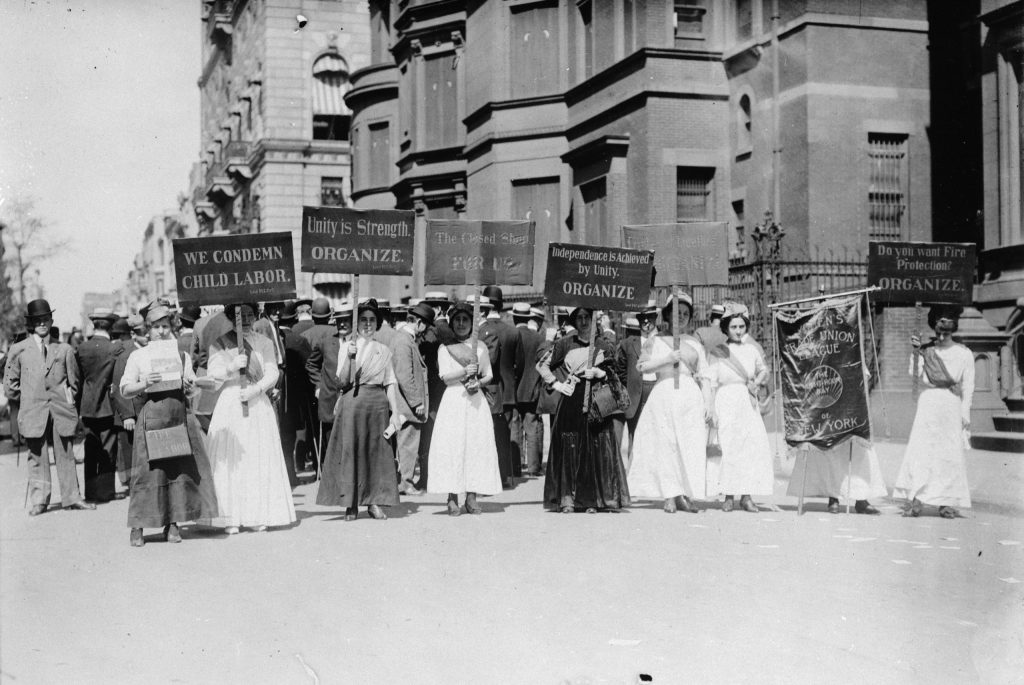 By Peter Dreier Outside the U.S., May 1 is international workers’ day. In Asia, Latin America, Europe, Africa, Australia, and Canada it’s normally observed with speeches, rallies, and demonstrations calling for higher wages and improved working conditions. Unlike the rest of the world’s democracies, the United States, which alone among first-world nations doesn’t require employers to provide workers with paid vacations, doesn’t celebrate May Day as an official national holiday. This year, the global Covid-19 pandemic will keep most workers around the world in their homes on May Day. But Americans are more aware of the plight of workers than at any time in decades. Despite the Trump administration’s incompetence and indifference in handling the virus crisis and the economic collapse, the courage and resilience of front-line health care workers, grocery store and drug store employees, farm workers, food processing workers, and many others are in the news. Trump’s most recent demand – that workers in meat-processing plants return to work as “essential” employees, with no guarantee of adequate safety measures – is is yet another example of why we need a stronger labor movement. Few sectors have been more disrupted by the current crisis than the tourism and sports industries, where millions of hotel, restaurant, stadium, and sports arena workers have lost their jobs. Last week, the labor movement in Los Angeles – which is heavily dependent on tourism – won a big victory when the City Council passed an ordinance by a 15-0 vote to require those businesses to offer jobs in the hospitality and other sectors to their former employees, based on seniority, at their existing wage levels, when they start rehiring. The measure will guarantee that workers are not replaced by newer, cheaper labor once the economy rebounds. UNITE HERE (the hotel workers union), the Los Angeles Alliance for a New Economy, and the Los Angeles County Federation of Labor spearheaded the campaign for the law. That coalition will now seek to get the state legislature to adopt a similar bill. But in too many other cities around the country, the 28 million people who have already applied for unemployment insurance remain vulnerable to further trauma, even if the economy starts to recover. The current crisis has exposed the fragility of the nation’s economy, as well as its health care and housing systems. As a result, many progressives are demanding a dramatic rethinking of what the country should do to improve living and working conditions for America’s families. That’s precisely what the nation’s radicals were thinking in the late 19thCentury when they first developed the idea for May Day. Yes, this international celebration of working-class solidarity was started in the United States by labor organizers. The holiday Americans had invented soon spread around the world, even if it never earned official recognition here. The original May Day was a byproduct of the movement for an eight-hour workday. After the Civil War, unregulated capitalism ran rampant in America. It was the Gilded Age, a time of merger mania, increasing concentration of wealth, and growing political influence by corporate power brokers known as Robber Barons. As the gap between the rich and other Americans widened dramatically, workers began to resist in a variety of ways. The first major wave of labor unions pushed employers to limit the workday to 10, then eight, hours. The 1877 strike by tens of thousands of railroad, factory and mine workers — which shut down the nation’s major industries and was brutally suppressed by the corporations and their friends in government — was the first of many mass actions to demand living wages and humane working conditions. By 1884, the campaign had gained enough momentum that the predecessor to the American Federation of Labor adopted a resolution at its annual meeting, “that eight hours shall constitute legal day’s labor from and after May 1, 1886.” On that first May Day, unions and radical groups orchestrated work actions and large-scale demonstrations in cities across the country. More than 500,000 workers went on strike or marched in solidarity and even more people protested in the streets. In Chicago, a labor stronghold, at least 30,000 workers struck. Rallies and parades across the city more than doubled that number, and the May 1 demonstrations continued for several days. The protests were mostly nonviolent, but they included skirmishes with strikebreakers, company-hired thugs, and police. On May 3, at a rally outside the McCormick Harvesting Machine Company factory, police fired on the crowd, killing at least two workers. The next day, at a rally at Haymarket Square (opens in a new tab) to protest the shootings, police moved in to clear the crowd. Someone threw a bomb at the police, killing at least one officer. Another seven policemen were killed during the ensuing riot, and police gunfire killed at least four protesters and injured many others. After a controversial investigation, seven anarchists were sentenced to death for murder, while another was sentenced to 15 years in prison. The anarchists won global notoriety, being seen as martyrs by many radicals and reformers, who viewed the trial and executions as politically motivated. Within a few years, inspired by both the American labor organizers and the Haymarket martyrs, unions and radical groups around the world had established May Day as an international holiday to celebrate the ongoing struggle for the eight-hour day, workers’ rights and social justice. In the U.S., however, the burgeoning Knights of Labor, uneasy with May Day’s connection to anarchists and other radicals, adopted another day to celebrate workers’ rights. In 1887, Oregon was the first state to make “Labor Day” an official holiday, celebrated in September. Other states soon followed. In 1894, the American Railway Union, led by Eugene Debs, went on strike against the Pullman Palace Car Company to demand lower rents (Pullman was a company town that owned its employees’ homes) and higher pay following huge layoffs and wage cuts. In solidarity with the Pullman workers, railroad workers across the country boycotted the trains with Pullman cars, paralyzing the nation’s economy as well as its mail service. President Grover Cleveland declared the strike a federal crime and called out 12,000 soldiers to break the strike. They crushed the walkout and killed at least two protesters. Six days later, Cleveland — facing worker protests for his repression of the Pullman strikers — signed a bill creating Labor Day as an official national holiday in September. He hoped that giving the working class a day off to celebrate one Monday a year might pacify them. For most of the 20th century, Labor Day was reserved for festive parades, picnics, and speeches sponsored by unions in major cities. Meanwhile, May 1 faded away as a day of protest in America, even though the Communist Party and other radical groups tried to keep the tradition alive. In 1958, at the height of the Cold War, with a renewed Red Scare still in full swing, even in the wake of the most virulent forms of McCarthyism, President Dwight Eisenhower proclaimed May 1 as Loyalty Day. Each subsequent president has issued a similar proclamation, although few Americans know about or celebrate the day. However, things have begun to change recently. In 2006, some U.S. unions and immigrant rights groups resurrected May Day as an occasion for protest. That year, millions of people in over 100 cities — including more than a million in Los Angeles, 200,000 in New York, and 300,000 in Chicago — participated in May Day demonstrations. Each year since immigrant workers and their allies have adopted May Day as an occasion for protest. America is now in the midst of a new Gilded Age with a new group of corporate Robber Barons, many of them operating on a global scale. The top of the income scale has the biggest concentration of income and wealth since 1928. Several decades of corporate-backed assaults on unions have left only seven percent of private-sector employees with union cards. More than half of America’s 15 million union members now work for the government (representing 37 percent of all government employees), so business groups and conservative politicians have targeted public-sector unions for destruction. Last week, Senate Majority Leader Mitch McConnel opposed federal relief funds to cities and states facing bankruptcy and massive layoffs, a plan designed to weaken government employee unions, who have led the fight against Trump and the Republicans. Meanwhile, a Brookings Institution report released in November found that more than 53 million people, or 44 percent of all workers ages 18 to 64, earn low hourly wages. Many families need more than two jobs to make ends meet, including one-fifth of all schoolteachers. But as wages and living standards for the majority of Americans have declined in the past decade, the appeal of unions has started to make a comeback. The new slogan for many unions is now “One job should be enough.” Congress hadn’t increased the federal minimum wage ($7.25) since 2009, so activists launched “The Fight for $15,” with wildcat strikes at fast-food and retail outlets prompting successful legislative initiatives and ballot campaigns. According to the National Employment Law Project, 24 states and 48 cities and counties will raise their minimum wages sometime in 2020. In 32 of those jurisdictions, it will reach or surpass $15 per hour. Activists also pressured McDonald’s, Walmart, Disney, Bank of America, and other large employers into raising their pay scales. The idea of a $15 minimum wage, a pipe dream in 2010, is now mainstream. The fight for higher wages has coincided with an upsurge of successful strikes by GM workers, and of teachers in both red and blue states. According to a recent Gallup poll, public support for unions reached a two-decade peak of 64 percent. There’s a growing demand for paid family leave – a policy that, had it been in place three months ago, would have lessened the suffering caused by the pandemic. During the current election season, many Democratic politicians have called for a federal $15 minimum wage, unlinking health insurance from jobs, reform of labor laws to make it easier for workers to unionize, a requirement that workers elect representatives to serve on the boards of U.S. corporations. Workers at Amazon, Walmart, and other companies will be engaged in a one-day job action on Friday. Renters around the country have planned a one-day rent strike. So, while there may not be big parades and mass protests on May Day in this pandemic year, there’s no reason why Americans can’t join together to sing “Solidarity Forever” –even if remotely — while sheltering in place. Peter Dreier is Professor of Politics at Occidental College. You can tweet with him @PeterDreier. May 1, 2020 On April 13, 2020 Bernie Sanders endorsed Joe Biden for President. It is highly likely that Biden will be nominated at the Democratic National Convention. This is, of course, disappointing to the movement that coalesced around Bernie’s campaign, and to the many DSAers that have played an active role within it. At the DSA convention in August 2019, DSA adopted a resolution to not endorse a Democrat if Bernie Sanders is not the nominee (Resolution 15). We respect the decision that DSA should not explicitly endorse a candidate for president who is not a democratic socialist. We are confident that DSA members recognize the danger of further consolidation of the nativist movement and that we will work with our allies to defeat Donald Trump. Donald Trump is unfit to be president. The list of his crimes is long and well known. The most glaring failures, corruption and depravity of his presidency have become fully realized with the Covid 19 crisis. The death toll of Covid 19 has struck the working-class as a whole, and African Americans, Hispanics, and other people of color in particular, in greater proportion than people working from home. Trump’s racism in calling the coronavirus the “China Virus” has incited many racist acts against Chinese Americans and Asian Americans more broadly. Despite Biden’s shortcomings and checkered past, a full array of issues overrides our reservations about him. At stake are issues such as judicial nominations; the climate crisis; women’s rights and reproductive choice; people of color’s and LGBTQ rights; the assault on immigrants; and the increasing burdens upon the working class. Most troubling is the Trump presidency’s promotion of incipient neofascism and racist white ethno-nationalism, and his ongoing efforts to dismantle governmental and social institutions. We therefore ask DSA members and allies who live in battleground or swing states and congressional districts to organize for the defeat of Trump. Of course, this includes voting for Biden, but it also means much more. DSA members should work with the myriad of organizations that will seek to push Biden to the left, in terms of both his policies and his appointees, including his choice for running mate. It also means helping elect democratic socialist and progressive candidates, especially those supporting Medicare for all, a Green New Deal, and taxing the rich, to Congress and state houses across the country. Ending control of the US Senate by the current GOP majority in thrall to the radical right is particularly crucial. We understand that the nomination of Biden confirms that for 2020 we have to choose between one candidate who is far from being a democratic socialist and another who is close to being a neofascist, but it is clear that another Trump term would be horrific. The opportunity to work with other socialist, progressive, and liberal groups can further build democratic socialism in the USA. We acknowledge that during the primary season working-class voters and African American voters made a choice that they felt was paramount in saving their lives. We commit to listen to the concerns of voters of color with respect and trust. We ask that DSA members in decisive locations work to defeat Trump in broad coalitions or fronts that allow others to see that DSA members are working for the common good. By working with others and selflessly giving our talents and energies in defeating the danger of neofascism, we will awaken in the people support for democratic socialism and respect for DSA. North Star Caucus of DSA. May 1, 2020. 1 Comment on Strategic Voting in the 2020 Presidential Election 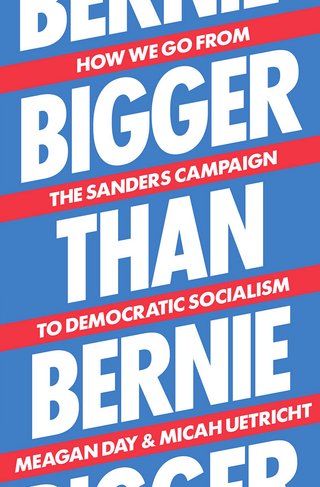 By Paul Buhle A recent sneering op-ed (opens in a new tab) in the New York Post was titled, “Suck it, Bernie Bros—the socialist dream is dead.” But is that dream really over? Today, as the unfolding COVID-19 crisis finds the economy in a tailspin, has the hope brought to millions by Sanders, the “Squad” of newly elected Congressional progressives, and a large peaceful army of organizers truly ended? Verso Books "Bigger Than Bernie" by Meagan Day and Micah Uetricht A new book offers a reassuring message. Bigger than Bernie (opens in a new tab), written by Meagan Day and Micah Uetricht, a staff writer and editor, respectively, at Jacobin magazine, both active members of the Democratic Socialists of America (DSA), reminds this reviewer, in form and content, of the old pre-1920 socialist popularizations: confident, good-humored, and easy to read. It shows that, minus the theoretical or dogmatic terminology and the projections of better societies somewhere else in the world, socialism looks suspiciously familiar. Maybe even American. The authors rehearse a history that’s well-known to many readers: the socialist movement’s recent return from obscurity, Sanders’s long journey toward his political apex, and the hopes now raised by today’s activists. Bigger than Bernie highlights how successful local socialist activity has been in recent years, most notably within the electoral realm where socialists have long done poorly. Since 1980, hundreds of Socialists have run for office (either as Democrats, or in nonpartisan elections) and have actually been elected, most famously in Chicago where they hold six seats (opens in a new tab) on the city council. Fellow members of Democratic Socialists of America in the Bay Area have a similar tale, but with a sharper edge. Here a socialist-like Teamster activist Jovanka Beckles, a queer black Latina immigrant, made a compelling pitch to working class voters in running for the California state assembly in 2018. Though losing narrowly, she racked up 90,000 votes (opens in a new tab). It was something to build from. And build they did. The infrastructure created in this campaign allowed the East Bay DSA to play the key support role in the Oakland teachers strike (opens in a new tab) a few months later. Bigger than Bernie radiates optimism, from chapter to chapter, because of the sense that American capitalism has overstepped its capacities, outraging the young in particular, who seek a path to a better future. Another recent volume on American socialism, We Own the Future: Democratic Socialism—American Style (opens in a new tab), is at once more ambitious and more distant. "We Own the Future: Democratic Socialism—American Style" edited by Kate Aronoff, Peter Dreier, and Michael Kazin A collection of essays edited by Kate Aronoff, Peter Dreier, and Michael Kazin, the book has been described by leading DSAers as the perfect compromise between “social democracy” and “democratic socialism,” lying somewhere between Hillary Clinton’s more or less neoliberal views and Sanders’s vision of a different kind of society. These outlooks are not so easily reconcilable, from foreign policy (sometimes hawks versus determined doves) to health care (Obamacare versus Medicare for All). But read carefully. All the writers in this volume, on issue after issue—corporate responsibility, immigration, race, families, urban life, and others—make thought-provoking arguments. Perhaps the great value of We Own the Future may be its outlining of the current debate within the Democratic Party: How far does Joe Biden’s presidential candidacy need to move leftward to encompass the vision of Sanders and his supporters? In Bigger Than Bernie, the authors stress the importance of rebuilding the labor movement. “Without a strong, organized working class that can challenge capital at the point of production in the private sector, and challenge government-imposed austerity at all levels in the public sector,” the authors write, “we will continue to encounter serious roadblocks to progress.” Sanders’s campaigns in 2016 and 2020, the authors say, “put class politics back on the map at an electoral level, but also helped stir organizing and militancy at workplaces throughout the country.” People were reminded “what they could demand and had the power to demand,” from schools to transportation. Perhaps it is too bold to say so, but Bernie Sanders shifted the ground under which we do our political work. Tags BOOK REVIEW DISPATCHES SOCIALISM BERNIE SANDERS Reposted from the Progressive. https://progressive.org/dispatches/bernie-sanders-and-our-day-of-destiny-buhle-200422/ (opens in a new tab) Paul Buhle, a retired labor historian, produces radical comics and is author and editor of four books on Madison, Wisconsin history. Read more by Paul Buhle By Max B. Sawicky At the risk of exploiting unforeseeable turns of events to validate all my priors, I want to argue that the unfolding of the 2020 Democratic primaries does not invalidate a DSA, class-oriented approach to politics. An example of a contrary view is Zack Beauchamp in “Why Bernie Sanders Failed.” His basic argument is that the Sanders’ campaign strategy rested on two premises that didn’t prove out. One was to ground the appeal to the working class and youth, which fell flat because black voters supported Biden, white workers who flirted with Bernie in 2016 are now for Biden or Trump, and youth didn’t turn out. Beauchamp concludes that identity and party affiliation trumped class. He fails to consider that those things are themselves founded on material self-interest, which is to say, class. There is widespread acknowledgment that Sanders’s proposals are popular. We could imagine that voters interpreted their class interest more broadly, and more pragmatically, than by supporting ambitious proposals such as Medicare For All, etc. In other words, they could have thought that Biden was the most electable candidate, so a vote for Biden was the best guarantor of their class interest. You could disagree with that judgment, but it’s not crazy, nor is it bereft of class consciousness. Some of us in DSA think a second Trump term will be a harbinger of a more open fascism. Defeating fascism is a legitimate, class-based interest too. Similar arguments apply to questions of identity or party affiliation. It’s plausible that Trump is viewed as profoundly inimical to black material interests, over and above his class warfare. Trump screws the working class, but there’s an extra turn of the screw for minorities. In this way of thinking, class may be de-centered, but it is not irrelevant. Nor is it a stretch for POC to reason that political power depends on alliances, which points back to electability. In other words, insofar as anyone understands at least some common interests with a broader group – the working class – they could see some sense in voting for Joe Biden. The same argument pertains to women, whose gender interests supplement, but do not supplant, those of class. As for racial or religious minorities, a pragmatic choice should not be conflated with indifference to class. Sanders was often criticized for a de-emphasis on race and gender. When the choice was between him and Hillary Clinton or Joe Biden, any hint of a relative shortcoming on issues of race was ridiculous. We could concede some grist for this mill in the case of gender, but only in comparison to Clinton. When it comes to party, Sanders has always rejected formal membership in the Democratic Party. But why are Biden voters Democrats in the first place? Is it possibly out of some conception of their class interest? We cannot reject that possibility out of hand. The Sanders movement may have been hampered by some misconceptions or biases. One goes to a running argument I had with those who complained that he failed to drop out in 2016 or this year when it became obvious he would not be nominated. But like DSA, the Sanders campaign is a movement, not a mere electoral vehicle. Its raison d’etre is to be self-sustaining. Sanders’s agitation for effective anti-virus policies are a current example. A presidential primary is another opportunity to preach the gospel. The irony here is that winning is not the only thing. Of course, it is better to win than not, but how you win or how you lose are equally important. You could win and be hamstrung, and discredited, or you could lose and have a lot of leverage. In either case, the table is set for future political opportunities. How you win or lose stems from how you campaign. It’s been reported that the Sanders campaign strategy was premised on the objective of beating other candidates, one-on-one, with a plurality of votes, what we could call a ‘thirty percent strategy.’ The urgency of winning this year by hook or crook, since it would be Sanders’s last rodeo, was totally understandable. But since the campaign is an ongoing movement to radically change capitalism, not just an electoral campaign, it should have been clear that this is not accomplished with 30 percent pluralities and a Congress full of meh Democrats. It’s a long-term project, a marathon rather than a sprint. Politically it requires not a thin majority, but a crushing one. Moreover, it must be about more than Sanders. There ought to be a new raft of emerging leaders. I love AOC as much as anyone, but we need more than one or four of her, and probably some with a decade or two of additional experience. The white component of the working class has played a positive political role at some points in U.S. history. It has not been uniformly negative, especially outside of the states of the Confederacy. Given the closeness of the 2016 election, it only requires the defection of a slender margin of Trump voters to swing the outcome. The usual alternative proposed to class politics is an appeal to ‘the suburbs.’ This is a bit of a misnomer. Of course, there are working class suburbs. What’s really in question is politics without a material, redistributive edge. “The suburbs” are invoked as being above class, as implicitly well-off, beyond precarity. A ‘suburban strategy’ is just a rhetorical device to evade class, an objectively anti-working-class stance. There is no neutrality in this dimension. You’re always on one side or the other. It remains the case that removing the Trump Administration is a necessary condition for progress, since progress requires democracy. Another four years of Trump further erodes voting rights, especially for youth and minorities, fills out the Federal judiciary with right-wing ideologues, and removes all regulatory constraints on capitalist predation. In that scenario, survival, much less opportunities for our revolution, look less likely. The 2020 primary campaign is over, but our movement goes on. Also See: Progressive Capitalism? Review of Joseph E. Stiglitz, People, Power and Profits: Progressive Capitalism for an Age of Discontent (W.W. Norton & Company, 2020). By Max B. Sawicky Joseph Stiglitz’s commitment to a “progressive capitalism” calls to mind the famous response of Gandhi to the notion of Western civilization: “It would be a very good idea.” Published in Jacobin. https://www.jacobinmag.com/2020/04/progressive-capitalism-joseph-stiglitz- a review Developed by on line discussion among North Star members., The proposed position. On April 13, 2020 Bernie Sanders endorsed Joe Biden for President. It is highly likely that Biden will be nominated at the Democratic National Convention. This is, of course, disappointing to the movement that coalesced around Bernie’s campaign, and to the many DSAers that have played an active role within it. At the DSA convention in August 2019, DSA adopted a resolution to not endorse a Democrat if Bernie Sanders is not the nominee (Resolution 15). We respect the decision that DSA should not explicitly endorse a candidate for president who is not a democratic socialist. We are confident that DSA members recognize the danger of further consolidation of the nativist movement and that we will work with our allies to defeat Donald Trump. Donald Trump is unfit to be president. The list of his crimes is long and well known. The most glaring failures, corruption and depravity of his presidency have become fully realized with the Covid 19 crisis. The death toll of Covid 19 has struck the working-class as a whole, and African Americans, Hispanics, and other people of color in particular, in greater proportion than people working from home. Trump’s racism in calling the coronavirus the “China Virus” has incited many racist acts against Chinese Americans and Asian Americans more broadly. Despite Biden’s shortcomings and checkered past, a full array of issues overrides our reservations about him. At stake are issues such as judicial nominations; the climate crisis; women’s rights and reproductive choice; people of color’s and LGBTQ rights; the assault on immigrants; and the increasing burdens upon the working class. Most troubling is the Trump presidency’s promotion of incipient neofascism and racist white ethno-nationalism, and his ongoing efforts to dismantle governmental and social institutions. We therefore ask DSA members and allies who live in battleground or swing states and congressional districts to organize for the defeat of Trump. Of course, this includes voting for Biden, but it also means much more. DSA members should work with the myriad of organizations that will seek to push Biden to the left, in terms of both his policies and his appointees, including his choice for running mate. It also means helping elect democratic socialist and progressive candidates, especially those supporting Medicare for all, a Green New Deal, and taxing the rich, to Congress and state houses across the country. Ending control of the US Senate by the current GOP majority in thrall to the radical right is particularly crucial. We understand that the nomination of Biden confirms that for 2020 we have to choose between one candidate who is far from being a democratic socialist and another who is close to being a neofascist, but it is clear that another Trump term would be horrific. The opportunity to work with other socialist, progressive, and liberal groups can further build democratic socialism in the USA. We acknowledge that during the primary season working-class voters and African American voters made a choice that they felt was paramount in saving their lives. We commit to listen to the concerns of voters of color with respect and trust. We ask that DSA members in decisive locations work to defeat Trump in broad coalitions or fronts that allow others to see that DSA members are working for the common good. By working with others and selflessly giving our talents and energies in defeating the danger of neofascism, we will awaken in the people support for democratic socialism and respect for DSA. North Star members please vote . You must be a member to vote. You can only vote once. First. Click on the link and go to the ballot. https://forms.gle/cWTQUnVPbKxYf8gt5 (opens in a new tab) Fill out the forms. Submit your ballot. 0 Comments on North Star Members Discuss Defeating Trump And Trumpism By Bill Fletcher, Jr. Leftlinks Trump's decision to cut funding for the World Health Organization (WHO)-which we warned about last week-is yet another example of his efforts to obscure reality and distance himself from any responsibility for the mess that the USA finds itself in as a result of his handling of the Covid19 crisis. There is a deeper problem, however, than Trump's apparent narcissism and scapegoating. We are seeing the consequences of avoiding reality and replacing reality with what can, at best, be described as wishful thinking. In the last couple of weeks very damaging information has emerged regarding the handling of the Covid19 crisis by the Administration. It now appears that as early as December 2019, the Administration was being warned about possible dangers from this outbreak. Indeed, from the early days of the Administration there were warnings from various departments of the danger arising from viral pandemics. These were ignored. The Administration brushed aside scientific evidence and concerns regarding the pandemic, downplaying its spread and the depth of the problems we were encountering. It was only in March that they were forced to shift gears. But in shifting gears the blame game started, afresh, with a focus on the Chinese, the WHO, and probably we shall soon hear that aliens from the Romulan Star Empire were somehow involved. Leaving aside the complicity of most Republican elected officials with the Administration's nonsense, it is time for a reckoning when it comes to reality. Should decisions by government in the face of crisis be based on wishful thinking? Self-aggrandizement? The wishes of the wealthy? Or should they be based upon facts, data, scientific judgement, and concerns for the population? The record is clear for anyone to see that the Trump administration blew off reliable information. One must ask why that is? Was it for fear that reality would have an impact on his election wishes? Or does he truly believe, in the words of the comedian George Wallace, that "...that's the way I see it, and that's the way that it ought to be..." Throughout the course of this Administration we have seen, time and again, a dismissal of facts and science. The clearest case is probably in connection with the environment and the efforts underway to reverse nearly fifty years of legislation and practice to address pollution and global warning. But one can also see evidence of this in the Administration's illogical withdrawal from the Iran nuclear deal, despite all reliable evidence of Iranian compliance with the agreement. The core of Trump's base appears to believe that if Trump says something, then it must be true. As for the rest of us, well, we will have to ensure that reality is incontrovertible, and to the benefit of the majority, in November. Bill Fletcher, Jr. is the executive editor of globalafricanworker.com and former president of TransAfrica Forum. As democratic socialists, you and I know that real COVID-19 relief needs to center working class needs, not prop up big business. You can help organize for real solutions now — sign up to support the Health Care Emergency Guarantee Act today! (opens in a new tab) Coronavirus relief bills have largely gone toward bailing out big corporations. And neoliberal Democrats want to keep it that way. Their plan for keeping laid-off workers insured during the pandemic is to give away massive subsidies to COBRA. Using tax dollars to cover increased premiums under COBRA for already expensive insurance plans is a massive bailout for private insurers. DSAers are leading the way for a relief package that centers the working class. That includes an emergency Medicare for All bill, which is why we are excited to endorse the Health Care Emergency Guarantee Act. Sen. Bernie Sanders just introduced this act as part of his coronavirus relief priorities. This emergency legislation would empower Medicare to cover all healthcare costs for the uninsured and all out-of-pocket expenses for those with insurance for the duration of the coronavirus crisis. We are launching a nationwide campaign to call on our representatives to support these priorities, and the Health Care Emergency Guarantee Act specifically. (opens in a new tab) No sick person, regardless of immigration status, should be afraid to seek the medical treatment they need during this pandemic. We are asking you to participate in virtual phone banks to mobilize DSA members and pressure your representatives to support Bernie’s legislation. Sign Up to Make CallsWe know that this is a difficult and uncertain time. But we need to do everything we can to ensure that the next relief bill puts the working class first. We’re working on creating resources for chapters. And here’s some resources you can use for your calls:
If you want to get involved in this work but aren’t sure how, reach out to your chapter leadership, or let us know by signing up here. (opens in a new tab) Solidarity, Maria Svart DSA National Director You’re invited to their A Planet to Win webinar this Sunday, 4/26 at 8pm ET/7pm CT/6pm MT/5pm PT! (opens in a new tab) DSA’s Ecosocialist Working Group invites you to join us for a national webinar with Thea Riofrancos, Daniel Aldana Cohen, and Alyssa Battistoni, the authors of A Planet to Win: Why We Need a Green New Deal, in conversation with Sydney Ghazarian, member of the DSA Green New Deal Campaign Committee and founding member of DSA’s Ecosocialist Working Group. RSVP here for the webinar on Sunday, 4/26 at 8pm ET/7pm CT/6pm MT/5pm PT. (opens in a new tab) Join us to talk about organizing in the midst of a global emergency heightened by a trio of ongoing crises — ecological breakdown under global warming, social breakdown under massive racial and economic inequality, and public health breakdown under threat of the Covid-19 pandemic. What can a radical Green New Deal look like? How can we connect the politics around these three civilization-threatening crises to build and win power to make a better world? How can DSA organize for a Green Stimulus and ensure that any Green New Deal incorporates radical demands around ecosocialist principles? This panel will be an opportunity to hear the authors’ thoughts on these topics and to ask your own questions about strategy and organizing for this moment. (opens in a new tab) After discussion and Q&A we’ll outline a series of Next Steps that will get you plugged in to our ongoing Green New Deal campaign. This will include the release of our Chapter Discussion Guide for the book, which will help chapters run political education around Green New Deal organizing as applied to your local conditions. You can find A Planet to Win at Verso Books. (opens in a new tab) Grab it now, read it twice, and get ready for an hour (or so) of careful socialist analysis and intelligent inspiration for your own organizing projects. And if you’d like to get involved on a regular basis, please become a member of the national Ecosocialist Working Group by filling out this form. (opens in a new tab) Solidarity and we'll see you on Sunday, 4/26 at 8pm ET/7pm CT/6pm MT/5pm PT. (opens in a new tab) Dissecting DSA’s battles to define its role in American politics By Harold Meyerson August 9, 2019 (Ed.: No, you are not reading an outdated piece. It is reposted here to clarify and explain the role of some caucuses and some “militants” in DSA.) It's a good thing that organizations don't have children or grandchildren. If they did, you could envision little tykes (well, little infant prodigies) 50 years from now asking their grandparent—the Democratic Socialists of America—“What did you do in the war against the neofascist Donald Trump?” only to be met by an awkward pause. At its biennial convention last weekend in Atlanta, DSA (which, with 56,000 members, is now the largest American socialist organization in the memory of anyone under 80) passed a headline-grabbing resolution declaring that it would not endorse any Democrat save Bernie Sanders in next year's November presidential runoff. The vote on the resolution was actually fairly close, though support for Sanders in the primaries is overwhelming within the organization. And its proponents provided a number of qualifications and caveats, making clear that DSA members are free to campaign for the eventual Democratic nominee if they so choose, and that in 2016, DSA locals did campaign against Trump (and members for Hillary) in swing states. Still, inasmuch as DSA locals work closely with immigrant-protection groups, and the national organization has called for the abolition of ICE, it could be difficult to explain to undocumented immigrants and asylum seekers, facing deportation and family separation, why the group won't join its allies in a forthright fight to dump Trump. However, I find myself of two minds in assessing DSA's position. As a member of the organization and one of its predecessors (the Democratic Socialist Organizing Committee) for the past 44 years, I'm embarrassed and regretful that my organization hasn't grasped the primacy and urgency of joining, in a public and full-blown way, the battle to rid the world of Trump. In 1944, the U.S. Communist Party effectively, if temporarily, self-abolished so its members could support Franklin Roosevelt's re-election bid, as part of the fight against fascism. To be sure, that move came at the behest of Joseph Stalin, whose nation was allied with ours in the existential battle against Hitler. But for all its myriad and ultimately fatal flaws, and granting that its self-abolition was a typical CP overreaction, the U.S. Communist Party understood the gravity of the fascist threat. Why not DSA? That's the reaction of my DSA mind. But partly through my long-ago work with DSOC, which led to my political work for some left-wing unions, which led to my own work for left-wing candidates and causes, I also seem to have a political-consultant mind. And that mind tells me that the eventual Democratic presidential nominee needs the formal endorsement of DSA like a hole in the head. Where DSA is strong and where socialist and progressive candidates can win—generally, in cities with substantial populations of millennials, immigrants, and minorities—a DSA endorsement can make all the difference, producing scads of the most tireless precinct walkers and dedicated phone-bankers. It has made that difference in New York, Chicago, and any number of smaller cities. In nearly every state, and certainly in the nation at large, however, a DSA endorsement would be one more item on the bill of particulars the Republicans would hurl at the Democratic nominee in hopes of revving up more of their right-wing base. In every encounter with reporters, the nominee would be pressed about DSA's endorsement. Just as well, says my consultant mind, that DSA takes a pass—particularly since I have no doubt most of my fellow members will end up helping that Democratic nominee in states where that help matters. I wouldn't be of two minds about DSA's electoral stance if the convention had passed one other resolution put before it last weekend, which laid out a list of conditions that candidates seeking DSA locals' endorsement for elected offices had to meet. Most of those conditions were unexceptionable; some could be met by nonsocialist progressives (Medicare for All) and some even by most mainstream Democrats (card check for union recognition, more-progressive taxation). The sticking point, though, was the condition that a candidate must publicly declare that he or she was a democratic socialist. Fortunately, DSA now has locals in 49 states, and delegates from some of those states noted that they came from terrains that didn't politically resemble Alexandria Ocasio-Cortez's congressional district in Queens and the Bronx. If a candidate's self-identification as a socialist was a requirement for their local's endorsement, they pointed out, they'd likely make no endorsements at all for the foreseeable future. Happily, the measure was defeated. Realism always welcome. How to explain that such measures nonetheless were backed by a core of more sectarian delegates, a number of whom make no bones about the fact that they'd prefer DSA to devote resources to building an explicitly socialist third party rather than back Democrats? That requires a look at the ideological makeup of DSA's activists, many of whom are affiliated with fairly well-defined caucuses. For most of its long history, DSA (and DSOC before it) didn't have ideological caucuses. It was at once both a small membership and big-tent organization. If you believed in democratic socialism, and thought that founder Michael Harrington made sense when he argued that socialists should be publicly active within the Democratic Party (thereby gaining more visibility for socialist candidates and causes, avoiding the third-party spoiler role, and easing outreach to progressive groups compelled to work in real-world politics), that sufficed as a minimal ideological and strategic orientation. Within those parameters, members had all kinds of different beliefs, orientations, and priorities, but not to the point of forming hard and enduring caucuses. (I do recall some particularly hefty guys in DSOC forming a “Mass Caucus,” with the slogan “One pound, one vote!” but its appeal was weightily limited.) Beginning with Bernie Sanders's declaration of his candidacy in 2015, DSA membership began to surge, and that was followed by two subsequent surges when Donald Trump was elected president and then when AOC ousted a prominent congressman in a 2018 Democratic primary. By early 2017, it was clear that DSA was fast becoming the largest socialist organization—by far—that America had seen in many decades. Which prompted a number of longtime socialists with perspectives substantially different from DSA's historic Harringtonism to join as well. DSA had become the arena where the future of American socialism was to be shaped; it provided an opportunity not to be missed. Among those who joined was a cadre of what Charles Lenchner (opens in a new tab) has referred to as Post-Trotskyists, though I think a better, if even more obscure, characterization would be Neo-Draperites. No American left tendency has been more fissiparous than the Trotskyists, who repeatedly have split over differences in doctrine, strategy, and sometimes personality, into various subgroups and sects, most demanding their members tithe a portion of their income to the group, some becoming hermetically sealed off from larger political arenas. Hal Draper was a democratic socialist who became a Trotskyist in the 1930s, followed Trotskyist heretic Max Shachtman into the Workers Party in the 1940s, and left to found the Independent Socialist Club in the 1960s, which became the International Socialists in 1968 (a heady year for the left), which he then left three years later, saying the group had become a sect. The International Socialist Tendency and groups like the International Socialist Organization soldiered on, never claiming much more than 1,000 members, if that, and sharing Hal Draper’s perspective that the Democratic Party was an arena to be shunned while third-party insurgencies provided opportunities for consciousness-raising and growth. These groups also believed that members should focus their labor involvement on rank-and-file activism and generally viewed union leaders and staff as bureaucrats retarding whatever embryonic revolutionary impulses could be found or nurtured among the workers. Under the banner of DSA's Left Caucus, renamed Momentum, then re-renamed Bread and Roses, a number of Neo-Draperites joined and came together in the newly vibrant DSA. In an organization of tens of thousands of new members, the vast majority in their twenties with little or no history of involvement in socialist groups, the Neo-Draperites were often the most experienced, and clearly the most organized, of DSA's new members. The problem was, their experience had been life in or around a small, disciplined sect. At the 2017 convention, for instance, they proposed a dues structure that amounted to tithing a portion of a member's income. That was how sects sustained themselves, but DSA was not an organization of professional revolutionaries (or even of professional evolutionaries), and the motion lost badly. At last weekend's convention, the motion to require all candidates that the organization endorsed to pronounce themselves socialists was also an expression of this sectarian impulse, and it lost badly, too. The irony here, of course, is that the Neo-Draperites would not have joined DSA in the first place if the group's Harringtonian strategy—calling for socialist activism within the Democratic Party rather than in ideologically purer third parties—had not been so clearly vindicated by Bernie Sanders and Alexandria Ocasio-Cortez, whose campaigns were what persuaded tens of thousands of young people to join DSA. The anti-establishment politics of the Neo-Draperites clearly had appealed to many younger members, and doubtless had some effect on the group's decision to withhold backing from any Democratic presidential nominee save Bernie. But it's hard to argue against any involvement in the Democratic Party when it was Bernie’s and AOC’s successes in Democratic primaries, and such successes in contests like those for the Chicago Board of Aldermen (five of whose members are now DSA members, too), that prompted thousands of young people to join DSA. The Neo-Draperite resistance not just to the Democratic Party but to the labor “establishment” as well had limited purchase on the delegates' sentiment. One such resolution, commending only rank-and-file involvement, passed narrowly, while a somewhat contradictory second resolution commending a more flexible involvement with the labor movement on multiple levels passed overwhelmingly. As one veteran DSA activist of decidedly Harringtonian perspectives told me, the Neo-Draperites “are a good group of people to have in the organization, given how deeply they commit themselves to the group's success. But they're constitutionally incapable of running a broad-based organization; their entire frame of reference is to life in a cadrefied movement.” In various locals, where Bread and Roses caucus members have been in leadership positions, members have revolted against top-down policies. At the national level, one anti-Momentum (then anti–Bread and Roses) Caucus, initially called Praxis, now called Build, has appeared to reject any form of central organization, calling variously for cutting back dues payments to the national organization, or even eliminating dues altogether. Fortunately, just as convention delegates rejected tithing two years ago, so last weekend they rejected shutting off the dues spigot to national DSA. Though Build favors maximal decentralization for DSA, it appears to be a disciplined and centralized caucus itself—as does Bread and Roses, but at least Bread and Roses is consistent in its commitment to organizational discipline. In the face of these two disciplined caucuses, other caucuses have formed to keep DSA from morphing into anything other than a broad-based, big-tent, democratic organization. Making plenty of errors along the way, like many of the youth organizations that DSA demographically resembles, I think the majority of DSA members will succeed in keeping the group from descending into the Scylla and Charybdis of sectarianism and anarchy. The electoral successes of DSA members running as Democrats—and there are now roughly 100 DSA members in elected office—will not just build the organization but help anchor it in the real world. And the presidential runoff of 2020? I think DSA's national political committee might take a leaf from the group's Atlanta local during Stacey Abrams's 2018 campaign for governor. At the time, the local wasn't endorsing nonsocialists, and some of its members likely believed—rightly, I'd say—that a DSA endorsement would be one more cross Abrams would have to bear in her bid to carry Georgia. Nonetheless, every other progressive group inside and outside the state was enthusiastically backing her, and many DSA members were eagerly working on her campaign. Here's what the local said: For many reasons, we cannot endorse Abrams ourselves, but neither can we stand aside while our friends and allies fight for something they know will make their lives better. We voted to encourage our members, if they feel so moved, to stand up and fight in this election cycle. In 2020, DSA's friends and allies—in immigrant communities and communities of color, in groups seeking to combat the climate crisis and save the planet, in organizations of working people seeking a radically more equitable economy and society—will be fighting for their lives to replace Trump with a Democrat. It won't be a battle between socialism and barbarism, but it will be a battle against barbarism, and the Atlanta statement offers a way that DSA can join it. (Ed.: Here is the original: https://www.google.com/amp/s/prospect.org/api/amp/power/socialists-just-did-and/) (opens in a new tab) 0 Comments on REverend William Barber: Refusal to Act for Justice is ImORAL Start at 22 minutes. Over 100 years ago, in the midst of the death and destruction of the First World War, German socialist leader Rosa Luxemburg wrote that capitalist society was at a crossroads and would either “transition to socialism or regress into barbarism.” In the 1930s, fascist parties took over Germany and other countries, and they indeed descended into genocidal barbarism. Today, in the center of western capitalism, the United States, the president, Republican senators, and major financial leaders are calling for an imminent return to business as usual that could kill millions — but at least temporarily save corporate profits. This is barbarism. The Evolving Crisis There are now nearly half a million confirmed Covid-19 cases worldwide, with more than 40,000 confirmed cases in the United States quickly spreading in the South. (opens in a new tab) Our caseload trajectory is rising faster (opens in a new tab) than anywhere else in the world and could soon make the U.S. (opens in a new tab) the center of the global pandemic. The virus is ravaging (opens in a new tab) New York’s healthcare system, and in Washington nurses describe their work (opens in a new tab) as analogous to war: “You’re in a battlefield where supplies are limited. The help’s slow to get to you and there’s lots of casualties and … you can’t see the enemy.” Decades of neoliberal austerity (opens in a new tab) have left most local governments and public health systems totally ill-equipped (opens in a new tab) to handle the crisis. 50% of those who die from Covid-19 have dying from secondary bacteria infections, (opens in a new tab) something Mike Davis warned (opens in a new tab)about in his critique of big pharma’s drive for profits. The FDA granted (opens in a new tab) the pharmaceutical giant Gilead seven years of monopoly on its drug, remdesivir, a possible treatment for coronavirus. Gilead is already known for price-gouging (opens in a new tab) life-saving HIV drugs. Activists with Asian Americans Advancing Justice (AAJC) are sounding the alarm about an uptick in violent attacks (opens in a new tab)against hundreds of Asian Americans, fueled by Trump’s racist rhetoric. Stock markets are rallying (opens in a new tab) as investors welcome the latest bailout package. But Fed officials predict unemployment figures (opens in a new tab) as high as 30 percent, which will snowball the economic havoc that’s in store. Government (In)Action Across the country, we’re seeing murderous levels of neglect and inaction. With Trump pushing (opens in a new tab) for a return to work by Easter, the new strategy is to starve workers (opens in a new tab) to protect the profits (opens in a new tab) of a few, risking the lives of millions in the process. New York Governor Andrew Cuomo announced plans (opens in a new tab) to force workers back to work in the epicenter (opens in a new tab) of the US outbreak while he recommended (opens in a new tab) $400M in cuts to Medicaid. The passing of the buck to state and local governments has resulted in wildly uneven responses across the country. This will only prolong the pandemic. (opens in a new tab) Democrats have reached (opens in a new tab) a deal with the Trump White House on the largest stimulus package in history — $2 trillion, including $500 billion in corporate aid. Early reports indicate that Bernie succeeded in his fight to add improved unemployment (opens in a new tab) support (opens in a new tab) for workers. Bailouts may be in order, but they must be equitable (opens in a new tab) and put people over profit. (opens in a new tab)We must reject a repeat (opens in a new tab) of the post-2008 corporate giveaway that lined capitalists’ pockets at the expense of workers! Some local governments have pursued steps guaranteeing rent grace periods, (opens in a new tab) eviction moratoriums, (opens in a new tab) and other relief measures aimed at cushioning the blow for workers. Joe Biden broke his week-long silence (opens in a new tab) on Monday with bizarre (opens in a new tab) and jumbled (opens in a new tab) videos (opens in a new tab) and interviews, (opens in a new tab) displaying a lack of basic leadership capacity. Meanwhile, Donald Trump has seen his highest approval (opens in a new tab) ratings as President, with a majority of Americans approving of his handling of the crisis. The leadership vacuum from anyone left of Trump shows why it’s more important than ever for Bernie Sanders to remain on the national stage. Bernie can retool his campaign (opens in a new tab) to lead the charge (opens in a new tab) against coronavirus and disaster capitalism as a surrogate (opens in a new tab) for an absent workers’ party. Workers Strike Back The diverse working class is organizing like we’ve never seen — fighting to shutter nonessential businesses to stop the spread of COVID-19 while winning paid time off for workers. Essential workers in healthcare, logistics, transportation, and grocery are fighting to protect themselves and our whole society. Healthcare: People are stepping up (opens in a new tab) to donate medical supplies to hospitals. It may not be fully sufficient, but this mutual aid is an important and much-needed act of solidarity! East Bay DSA is hosting (opens in a new tab) a digital townhall to hear from frontline healthcare workers in Oakland. Don’t miss it. (opens in a new tab) Transit: Following Detroit’s example, (opens in a new tab) organized transit workers in Toronto (opens in a new tab) and Alabama (opens in a new tab) won rear boarding and free fares for riders to protect the public and the workers. Union taxi workers in Los Angeles have issued demands (opens in a new tab)ranging from social distancing protocols to the expansion of SNAP for all essential workers. Logistics: The presidents of two of the largest unions at Bath Iron Works on Tuesday called on the company (opens in a new tab) to close and give employees paid leave for two weeks to protect the company’s 8,000 workers. Grocery: Grocery workers in Berkeley won a $2/hour raise as hazard pay during the pandemic after gathering over a thousand signatures (opens in a new tab) in their petition. H-E-B workers (opens in a new tab) also won a temporary $2/hour hazard pay raise. Bosses at Kroger are so scared of workers organizing that they banned (opens in a new tab) the website Labor Notes (opens in a new tab) on their wifi. Check out the article (opens in a new tab) that shook them up. Instacart is hiring (opens in a new tab) hundreds of thousands of new workers to handle new demand for delivered groceries. We must support these workers in getting protection, support, and hazard compensation for this frontline work. Agriculture: In Georgia, Perdue plant workers walked out (opens in a new tab) in protest of their unsafe working conditions and lack of hazard pay. Coffee Shops: After gathering over 24,000 signatures on a petition demanding (opens in a new tab) the company close stores, Starbucks workers won. (opens in a new tab) We’re Fighting For the World Like Rosa Luxemburg a century ago, democratic socialists are fighting for a just, equal, healthy, and environmentally sustainable world. Under capitalism, private profit for billionaires drives our economy, (opens in a new tab) our energy system, (opens in a new tab) our government, (opens in a new tab) and more. This profit is in effect stolen (opens in a new tab) from the labor of millions of exploited, oppressed, overworked, and underpaid workers and from our environment. The pursuit of profit drives the privatization of energy, (opens in a new tab) water, (opens in a new tab) schools, (opens in a new tab) transportation, (opens in a new tab) and healthcare (opens in a new tab) — driving the coronavirus pandemic to cause far more human suffering than it would otherwise. Profit drives the military (opens in a new tab) and prison industrial (opens in a new tab) complexes, the division of workers (opens in a new tab) along the lines of race and nationality, and the devastation of our planet. Capitalism as a social system only benefits the already rich at the expense of everyone else. Democratic socialism (opens in a new tab) is the only (opens in a new tab) cure to the disease that is capitalism. Workers—united across geography, ethnicity, gender, and age—are the ones who will win it. DSA Announcements
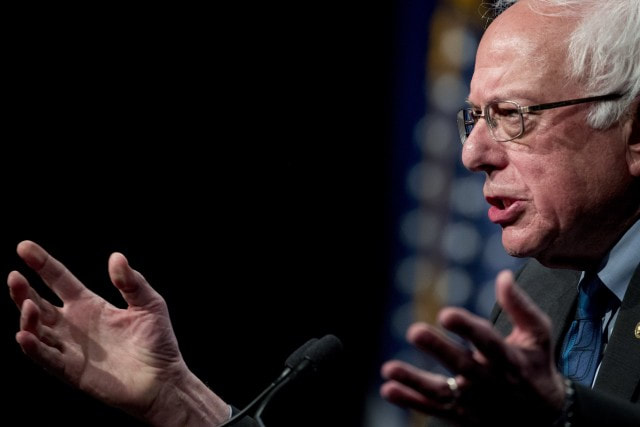 Bernie Sanders In terms of potential deaths and the impact on our economy, the crisis we face from coronavirus is on the scale of a major war, and we must act accordingly. We must begin thinking on a scale comparable to the threat, and make sure that we are protecting working people, low-income people, and the most vulnerable communities, not just giant corporations and Wall Street. Empower Medicare to Lead Health Care Response
2. Establish an Emergency Economic Crisis Finance Agency to manage the economic crisis This emergency agency, modeled after the Reconstruction Finance Corporation, will be empowered to cover affected businesses’ payroll, make zero percent loans and loan guarantees to businesses, finance new construction of factories, emergency shelters, and production of emergency supplies such as masks and ventilators, and create new jobs and economic development. This agency will provide all the necessary funding for fighting this economic crisis.
Our response to this health and economic crisis cannot be another money-making opportunity for corporate America and Wall Street. We need to establish an oversight agency to ensure no one is profiting off of the economic pain and suffering of our people in crisis.
0 Comments on An Emergency Response to the Coronavirus Pandemic Wow! Over 1180 people joined our COVID-19 People Over Profit Mass Call last night. You can watch the recording here. (opens in a new tab) Every day we hear more bad news, but there are also amazing stories of workers fighting back or people helping their neighbors. We’ll pull through if we pull together, and last night with you felt powerful. As promised, here are critical links we discussed on the call. Sign up to get our new DSA COVID-19 Bulletin several times a week. (opens in a new tab) Sign and share DSA’s COVID-19 Demands petition. (opens in a new tab) Register for an upcoming national Zoom organizing call. (opens in a new tab)
Check out the DSA Collaborative COVID-19 One-Stop memo. (opens in a new tab) It includes info about the Twin Cities phone zap tactic if you want to try it in one of your campaigns! Sign up to get advice on organizing with your co-workers during the COVID-19 crisis. (opens in a new tab) Join DSA if you’re not already a member, become a monthly member if you’re not already, or ask 3 of your friends to join. (opens in a new tab) Onward! Maria Svart DSA National Director 0 Comments on recording of DSA blog Call on the Covid Virus organizing |