Trump’s Immigration Order: A Fast Track to an Abusive Past for Agricultural Workers
David Bacon,
July 2, 2020.
On June 24, new COVID-19 cases passed 200 (opens in a new tab) in one day in rural Yakima County in central Washington state for the third time this June. That brought the total number of people infected to 6,940, and the number of the dead to 132. The infection toll for Seattle’s King County, with a population ten times larger than Yakima’s, was 9,453.
COVID numbers are spiking in farmworker communities all over the United States. On June 26, the Imperial Valley (opens in a new tab), on the California-Mexican border, the source of winter vegetables worth over $1.8 billion per year, registered 5,549 cases and 70 deaths. In California’s huge San Joaquin Valley, Fresno County (opens in a new tab) had 3,892 infections and 71 deaths, and Kern County (opens in a new tab) had 4,108 cases and 63 deaths. Collier County (opens in a new tab) in Florida, center of the U.S. tomato crop and headquarters of the Coalition of Immokalee Workers, had 3,778 cases and 70 deaths. Cumberland County (opens in a new tab), New Jersey’s agricultural heartland, had 2,876 cases and 124 deaths, and nearby Chester County (opens in a new tab), Pennsylvania, where workers labor in Kennett Square’s mushroom sheds, had 3,437 cases and 313 deaths. In Arizona’s Yuma County (opens in a new tab), an irrigated desert along the Colorado River, there were 5,323 cases and 76 deaths.
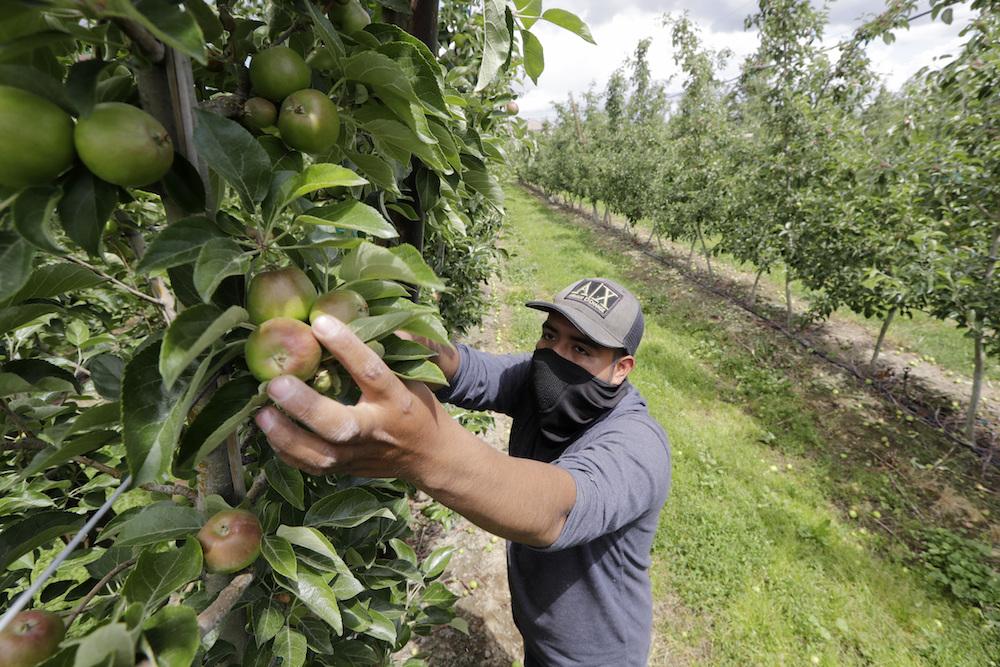
This raging rural infection rate, which tracks those of urban counties many times their size, is not due to a refusal by farmworkers to wear facemasks. It is a function of structural racism—the way immigrants in general, and farmworkers in particular, are treated as disposable labor. People in the fields are viewed as machines, whose ability to work is the only aspect of their human value worth considering.
There is no clearer demonstration of this fact than the immigration order (opens in a new tab) issued by the Trump administration on June 23. President Trump boasted that he would “preserve jobs for American citizens” (opens in a new tab) by stopping the recruitment of guest workers in four visa categories. He failed to mention, however, that he was leaving untouched the country’s main guest worker program, under which growers bring farm laborers to the U.S.—the H-2A visa program (opens in a new tab).
Faced with the need to please agribusiness, Trump made clear that no rhetoric about family values applies to farmworkers. H-2A migrants cannot bring a wife or a child with them (the program notoriously discriminates against hiring women), so they live the lives of lonely men in barracks. And in its most significant impact on families, Trump’s order would close down the country’s historic path for keeping families together—the family preference system for granting residence visas, or “green cards.”
There’s nothing new about streamlining the labor supply for growers, making it cheaper and more vulnerable, under the cover of anti-immigrant rhetoric.
Trump’s order ostensibly stops the issuance of visas for four much smaller guest worker programs, including H-1B for workers in health care and high tech; H-2B for non-agricultural workers, mostly in landscaping, forestry, and food processing; L-1 for corporate executives; and J-1, the visa for students in cultural exchange programs, au pairs, and university researchers.
Nativist anti-immigrant organizations duly praised the order, which a senior administration official claimed to Vox “would open up 525,000 jobs.” (opens in a new tab) The anti-immigrant Center for Immigration Studies (opens in a new tab) declared, “Now there is a new sheriff in town. For the first time, a president has stood up for the American people.” According to Tom Homan (opens in a new tab), former acting director of Immigration and Customs Enforcement under Trump, “With record unemployment crushing millions of Americans ... importing more foreign labor ... is simply unacceptable.”
(Ed.: Read the entire piece (opens in a new tab).)
Duane Campbell